
Table of Contents
- What Causes Driving Anxiety in Beginners
- Breathing and Grounding Techniques to Calm Your Nervous System
- How to Find Patient Driving Instructors Who Understand Anxiety
- Gradual Exposure: Building Confidence Step by Step
- Tips for New Drivers with Anxiety: Managing Panic Behind the Wheel
- ICBC Road Test Preparation for Nervous Drivers
- Technological Aids and the Passenger-to-Driver Transition
- Conclusion
- Frequently Asked Questions
Last Updated: September 23, 2026
What Causes Driving Anxiety in Beginners
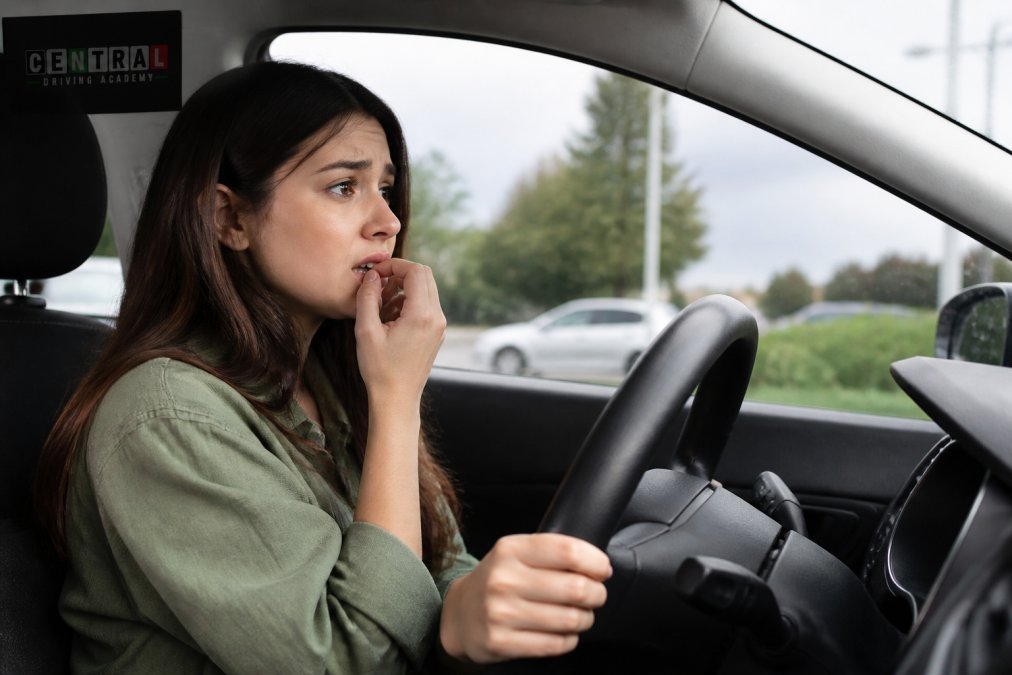
Driving anxiety is a persistent fear or worry about operating a vehicle, and it affects new drivers far more often than most people admit. This guide from Central Driving Academy breaks down why it happens and what you can do about it.
The root cause usually comes down to one thing: your brain treats driving as a threat.
You’re moving a heavy machine at speed. You’re watching mirrors, signs, and other cars at once. One wrong move feels like it could hurt someone. So your body reacts the way it would to any danger.
Common psychological triggers behind the wheel include:
- Fear of losing control at higher speeds
- Fear of judgment from other drivers honking or tailgating
- Past scares, like a near-miss or a minor collision
- Pressure to perform during lessons or a road test
- Sensory overload from traffic, noise, and quick decisions
Avoidance makes it worse. Every skipped lesson teaches your brain that driving really is dangerous.
Driving anxiety is a learned fear response, not a character flaw. That matters because learned responses can be unlearned with the right approach.
Breathing and Grounding Techniques to Calm Your Nervous System
Grounding techniques work because they interrupt the fear response before it takes over. The goal is nervous system regulation: slowing your heart rate and pulling your attention back to the present moment.
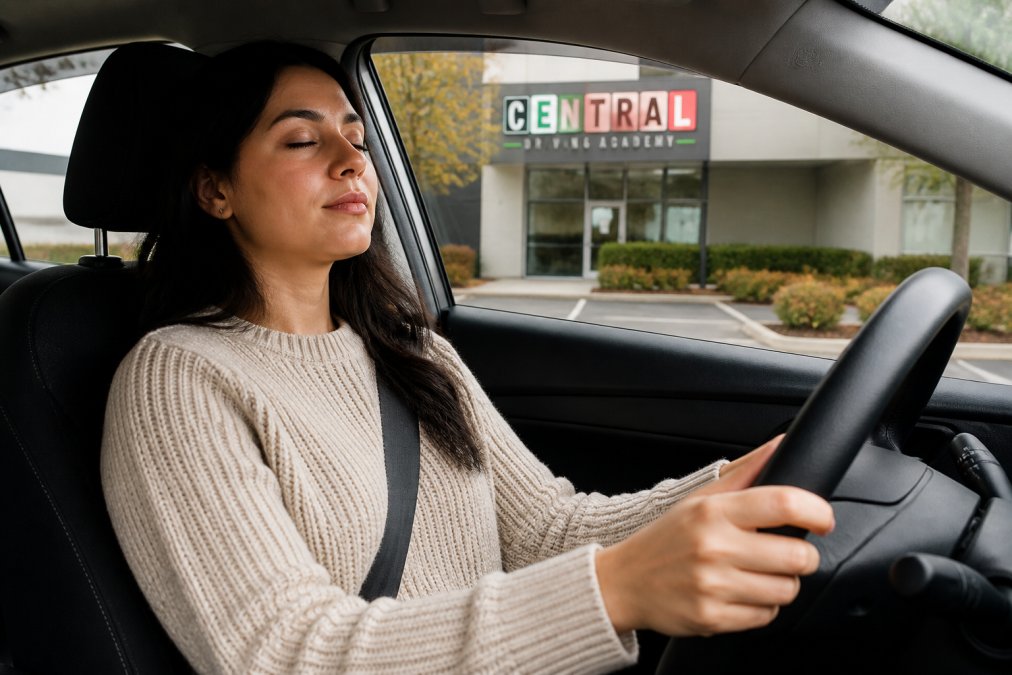
Start with box breathing.
Other tools that help:
- Name five things you can see, four you can hear, three you can touch
- Press your feet firmly into the floor mats
- Hum a note and feel the vibration in your chest
How to Find Patient Driving Instructors Who Understand Anxiety
The right instructor can make or break your progress. A patient instructor knows that anxiety isn’t something to push through, it’s something to work with.
- How do you handle a student who panics mid-lesson?
- Do you offer a free assessment before committing to a package?
- Can you explain a maneuver more than once without frustration?
- Do you teach in a language I’m comfortable speaking?
Book a single lesson before buying a package. You’ll learn more about an instructor’s patience in one hour than in any review.
Gradual Exposure: Building Confidence Step by Step
Gradual exposure means facing driving in small, manageable steps instead of all at once. This is the core of desensitization, and it’s how most people actually beat driving phobia. The principle is simple: each safe drive teaches your nervous system that the activity is not the threat it predicted.
Creating Your Exposure Hierarchy
Build a list from least scary to most scary, then work up slowly. Here’s a starting framework:
| Step | Situation | Goal |
|---|---|---|
| 1 | Sit in the driver’s seat, engine off | Get comfortable with the controls |
| 2 | Start the car in a quiet parking lot | Feel the engine and pedals |
| 3 | Drive loops in an empty lot | Practice steering and braking |
| 4 | Drive quiet residential streets | Handle low-speed turns |
| 5 | Drive during light traffic | Manage other cars |
| 6 | Drive a familiar route | Build a routine |
| 7 | Drive during busy hours | Handle pressure |
The Mechanics Most Guides Skip
A hierarchy only works if you run it correctly. A few rules matter more than the list itself:
- Frequency beats duration. Three 20-minute sessions a week build more tolerance than one two-hour marathon. Short, repeated wins retrain the fear response faster.
- Cap each session before anxiety peaks. End on a calm note, not a panicked one. If you finish while you still feel steady, your brain files the drive under “safe.”
- Repeat a step at least twice before moving up. One good drive can be luck. Two good drives is a pattern.
- Keep a simple log. Note the date, the route, the duration, and a one-word anxiety rating. Patterns show up fast, most learners discover their fear is route-specific or time-of-day specific, not driving-wide.
Skipping steps to save time usually backfires. One bad experience at step 6 can send you back to step 2.
When a Step Goes Badly
A rough session is not a failure, it’s data. The mistake is quitting the hierarchy entirely. Instead:
- Drop back one step for your next session and rebuild the win.
- Change one variable: a quieter time of day, a shorter route, or a different vehicle.
- Debrief with your instructor or a trusted passenger about what specifically triggered the spike.
Two Gaps Most Guides Miss
Re-entry anxiety. If you already hold a licence but haven’t driven in years, your hierarchy should start lower than a brand-new learner’s, not because you’ve forgotten how, but because your avoidance has had more time to harden. Start at step 1 even if it feels silly. The point is to overwrite the old association, not to prove you can still drive.
Exposure works because it’s boring. If a step still spikes your heart rate, you’re not ready to move up, and that’s information, not failure.
Tips for New Drivers with Anxiety: Managing Panic Behind the Wheel
Panic attacks behind the wheel feel terrifying, but they follow a pattern you can interrupt. The trick is catching the early signs before your body fully reacts.
Watch for these warning signs:
- Tight chest or shallow breathing
- Sweaty palms and a racing heart
- Tunnel vision or trouble focusing
- Urge to pull over immediately
Why Self-Talk Actually Works
Self-talk matters here because panic is fed by catastrophic predictions, “I’m going to lose control,” “I’ll cause an accident.” Replacing “I can’t do this” with “I’m safe, I’m parked, and I can take my time” isn’t positive thinking for its own sake. It interrupts the prediction loop long enough for your nervous system to downshift. The statement has to be specific and true in the moment, which is why “I’m parked” works better than “I’m fine.”
Coping Mechanisms That Hold Up in Real Traffic
- Drive the same route repeatedly until it feels automatic
- Keep a water bottle within reach
- Avoid caffeine before lessons, it mimics the physical symptoms of anxiety and can trigger a false alarm
- Practice during quieter times of day at first
- Narrate your decisions out loud (“mirror, signal, shoulder check”) to keep your attention on the task instead of the feeling
The Role of Cognitive Behavioral Therapy
If panic attacks happen often, talk to a doctor or therapist. Cognitive behavioral therapy (CBT) is well documented for treating anxiety disorders, and it pairs well with behind-the-wheel practice. The reason it fits driving anxiety specifically is that CBT targets the two things that keep the fear alive: catastrophic thoughts and avoidance.
A typical CBT approach for driving anxiety involves:
- Identifying the automatic thought at the moment of panic (“I’ll stall and everyone will honk”)
- Testing it against evidence (how many times has that actually happened?)
- Running a behavioral experiment, deliberately stalling in a safe lot to prove the outcome is survivable
- Recording the result so the next panic has a counter-example to draw on
Pair one CBT technique with one behind-the-wheel session each week. The therapy gives you the tool; the drive gives you the proof.
ICBC Road Test Preparation for Nervous Drivers
Road test anxiety is normal, and preparation is the best antidote. ICBC road test preparation for nervous drivers starts with knowing exactly what the examiner checks.
Focus your practice on:
- Shoulder checks before every lane change
- Full stops at stop signs, held for three seconds
- Mirror and signal use at every turn
- Defensive driving habits, like scanning intersections
Technological Aids and the Passenger-to-Driver Transition
Two things trip up new drivers that most guides skip: vehicle-specific anxiety and the shift from passenger to driver.
Helpful technological aids include:
- Backup cameras and parking sensors
- Blind spot monitors
- Lane-keeping alerts
- GPS with voice directions
Learners who feel confident in one vehicle but anxious in another, or who are moving from years of being a passenger to driving solo.
Conclusion
Driving anxiety doesn’t disappear overnight, and that’s okay. What matters is steady practice, the right support, and a plan you can follow step by step.
Frequently Asked Questions
How to get over driving anxiety quickly?
There is no instant fix, but you can calm your nervous system within minutes using box breathing: inhale for four counts, hold for four, exhale for four, hold for four. Pair this with grounding techniques like naming five things you can see. For lasting relief, gradual exposure and professional driving lessons build confidence over weeks, not days. A patient instructor can help you practice in low-pressure environments first.
What are the common signs of driving anxiety in new learners?
New learners often experience a racing heart, sweaty palms, tight chest, and shallow breathing before or during driving. Some feel nauseous or get a dry mouth. Mentally, you might replay worst-case scenarios, avoid routes you find intimidating, or feel irritable after lessons. These are normal fear responses, not signs you are bad at driving. Recognizing them early lets you use coping mechanisms like self-talk and breathing before anxiety escalates.
How can professional driving lessons help reduce anxiety?
A certified instructor provides a structured, low-pressure environment where mistakes are expected and corrected calmly. They can break skills into small steps, which is gradual exposure in practice. Instructors trained to work with nervous drivers use reassuring self-talk, explain what to expect, and help you build an exposure hierarchy. They also prepare you for the ICBC road test, so the test itself feels familiar rather than frightening.
How do I prepare for my first road test if I am nervous?
Start ICBC road test preparation early by driving the test routes with a patient instructor. Practice defensive driving habits, shoulder checks, and parking until they feel automatic. On test day, use box breathing and grounding techniques before you start. Remember that the examiner assesses road safety, not perfection. Booking a mock test or extra lessons with a certified instructor can turn nervous energy into focused, proactive driving.