

Table of Contents
- Understanding ICBC Class 7 Road Test Requirements
- What’s Changing in 2026: Graduated Licensing Program Updates
- Essential ICBC Road Test Checklist 2026
- Pre-Test Preparation: Building Driving Confidence
- Common ICBC Road Test Mistakes to Avoid
- Key Driving Maneuvers and Skills Tested
- Booking Your Road Test Appointment
- The Day of Your Test: What to Expect
- Frequently Asked Questions
Last Updated: September 20, 2026
Understanding ICBC Class 7 Road Test Requirements
To pass an ICBC road test, you must demonstrate that you’re ready to drive independently on public roads through this practical examination. It evaluates your ability to operate a vehicle safely, follow traffic laws, and respond appropriately to real-world driving situations.
The Class 7 test typically lasts 30-40 minutes and includes various driving scenarios: residential streets, highways, intersections, and parking maneuvers. Your examiner will assess how well you handle vehicle control, hazard perception, and decision-making under pressure.
Examiners check whether you can drive safely in real conditions: smooth acceleration and braking, proper mirror checks, appropriate speed control, and calm responses to unexpected situations.
Most learners focus on perfecting individual maneuvers but miss the bigger picture: examiners want to see consistent, safe decision-making throughout the entire test. A slightly imperfect parallel park won’t fail you, but failing to check your blind spot before changing lanes will.
What’s Changing in 2026: Graduated Licensing Program Updates
The 2026 updates refine assessment criteria and testing procedures to reflect modern road conditions and emerging safety concerns.
The 2026 updates emphasize hazard perception and defensive driving: examiners evaluate whether you scan ahead, check mirrors frequently, and position your vehicle defensively in traffic.
The test includes more complex intersection scenarios and heightened attention to school zones and playground zones.
Examiners assess your ability to drive safely without relying solely on technology, using traditional skills like mirrors, shoulder checks, and manual steering awareness.
The core message of 2026 changes: ICBC wants drivers who think ahead and make proactive safety decisions, not just follow rules mechanically. Your preparation should emphasize understanding why rules exist, not just memorizing them.
Essential ICBC Road Test Checklist 2026
Documentation and Identification
Bringing correct documentation is non-negotiable; without it, you won’t be permitted to take the test.
You’ll need a valid Class 7 learner’s license (physical card, not digital) and government-issued photo identification showing your name and date of birth.
Bring your Social Insurance Number or a document containing it, and have your learner’s permit information accessible.
Double-check all documents the night before and organize them in a folder for test day.
Vehicle Safety and Insurance Requirements
Your vehicle must be registered with valid liability insurance in effect on test day; expired coverage cancels your appointment.
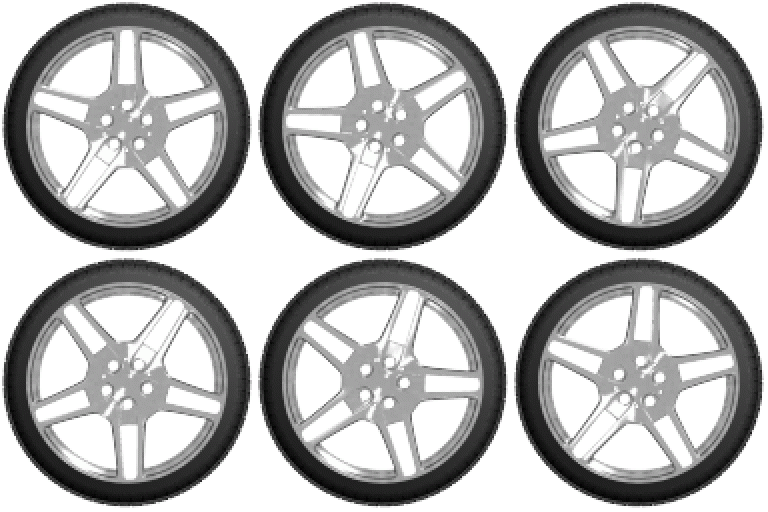
Tires must have adequate tread depth (at least 1.6 millimeters, or 2/32 of an inch) (Riding On Air). All lights must work: headlights, brake lights, turn signals, and dome light. Wipers, mirrors, and windshield must be in good condition.
Seatbelts, horn, and doors must function properly. Vehicle must have valid registration plates and sufficient fuel.
A common mistake is assuming your vehicle is fine because you’ve been driving it for months. Test vehicles are inspected more rigorously than your everyday driving requires. Bring the vehicle to a mechanic for a pre-test inspection if you’re uncertain about its condition.
Pre-Test Preparation: Building Driving Confidence
Mental Preparation and Nervous System Regulation
Nervous system regulation is critical for test performance. Anxiety narrows attention and impairs decision-making; a calm nervous system enables clear thinking and smooth vehicle control.
Practice the 4-7-8 breathing technique (inhale for 4 counts, hold for 7, exhale for 8) for 2-3 minutes daily to activate your parasympathetic nervous system.
Spend 5-10 minutes daily visualizing your test route and scenarios to prime your brain and reduce novelty on test day.
Regular exercise reduces anxiety and improves focus. The night before, avoid caffeine and get adequate sleep. Eat a balanced meal on test morning.
Arrive 15 minutes early and take three deep breaths in the parking lot to settle your nervous system.
Vehicle-Specific Pre-Check Guides
Familiarize yourself with the specific vehicle you’ll use for testing to eliminate surprises and build confidence.
If using your own vehicle, practice its specific characteristics: brake sensitivity, steering response, mirror positioning, turning radius, and handling on different surfaces.
If using a school vehicle, request a familiarization session to adjust mirrors, seat, and steering wheel, and locate all controls.
Check visibility and blind spots. Practice your pre-drive inspection routine: walking around the vehicle, checking tires, verifying lights, and confirming mirror positioning.
Practice in the actual test vehicle as much as possible to avoid transition struggles.
Common ICBC Road Test Mistakes to Avoid
Most learners who fail to pass an ICBC road test do so because of preventable mistakes that demonstrate inattention or rule violations.
Failing to check mirrors and blind spots is the most common failure. Shoulder checks before lane changes, merging, and turning are essential and take only two seconds.
Speed limit violations are automatic failures: driving 5-10 km/h over in residential or school zones, or more than 10 km/h under the limit.
Improper positioning at intersections shows lack of control. Practice all intersection types: controlled, uncontrolled, and complex multi-lane intersections.
Failing to anticipate hazards costs points. Constant scanning and defensive positioning, staying back from parked cars, slowing for pedestrians, maintaining escape routes, are essential.
Panic braking or jerky acceleration demonstrates poor control. Practice smooth, gradual pedal pressure until movements are fluid.
Failing to follow the examiner’s instructions immediately is an automatic failure. Listen carefully, confirm you understand, and execute the instruction without hesitation or questions. If you don’t understand, politely ask for clarification before proceeding.
Key Driving Maneuvers and Skills Tested
Intersection Navigation and Right-of-Way
Intersections are where most failures occur; they require attention to traffic signals, pedestrians, other vehicles, positioning, and right-of-way rules.
At controlled intersections, approach at correct speed, position in lane center, check for pedestrians and red-light runners, signal 30 meters before turning, and complete turns smoothly.
At uncontrolled intersections, come to a complete stop, look left-right-left, and yield to approaching vehicles even if you have right of way.
Right-of-way rules trip up many learners. At a four-way stop, the vehicle that arrives first has the right of way. If two vehicles arrive simultaneously, the vehicle on the right has priority. When turning left across oncoming traffic, yield to that traffic. When entering a roundabout, yield to traffic already in the roundabout.
Complex intersections with multiple lanes require careful positioning. Signal your intended lane well in advance. Check mirrors and blind spots before changing lanes. Don’t change lanes within the intersection itself.
Parking and Reversing Techniques
Parking maneuvers test your spatial awareness and vehicle control. The two primary parking scenarios on the ICBC road test are parallel parking and reverse stall parking.
For parallel parking, position your vehicle about 60 centimeters (roughly 2 feet) from the parked car in front of the space. Check your mirrors and blind spots. Reverse slowly while turning your steering wheel fully to the right. When your vehicle is at approximately a 45-degree angle, straighten your wheels and continue reversing.
Booking Your Road Test Appointment
Booking your ICBC road test appointment requires planning. Appointments fill quickly, especially during peak seasons (spring and summer), so book as early as possible, ideally 6-8 weeks before your target test date.
The Day of Your Test: What to Expect
Test day begins the moment you arrive at the testing center. Arrive 15 minutes early. This gives you time to check in, use the washroom, and settle your nervous system. Bring all required documentation and keep it organized and accessible.
Frequently Asked Questions
What are the most common reasons for failing an ICBC road test?
The top reasons include improper mirror and blind spot checks before changing lanes, failing to maintain appropriate speed in school and playground zones, poor hazard perception and delayed reactions to traffic changes, and mistakes during parking maneuvers such as hitting the curb or exceeding space boundaries. Many test-takers also lose points for not making proper shoulder checks or failing to demonstrate right-of-way understanding at controlled intersections. Practicing these specific skills reduces failure risk significantly.
What documents and identification do I need to bring to my ICBC road test appointment?
You must bring a valid Class 7 learner’s license, government-issued photo identification (passport, provincial ID, or driver’s license from another province), proof of vehicle insurance, and vehicle registration. Some examiners may also request your learner’s logbook if you’re required to maintain one under the Graduated Licensing Program. Verify the current requirements with ICBC before your appointment, as documentation rules can change.
What vehicle requirements must be met for an ICBC road test?
Your vehicle must have valid registration, current insurance, functioning safety equipment (lights, wipers, brakes, seatbelts), and a valid inspection sticker. The vehicle must be in safe, roadworthy condition with no obvious defects. You’ll need a vehicle that’s reliable enough to complete a 30-40 minute test route without mechanical issues. Some driving schools provide road test vehicles if yours doesn’t meet requirements, which removes uncertainty on test day.
How have the Graduated Licensing Program requirements changed for 2026?
The 2026 updates to the Graduated Licensing Program refine supervision requirements, driving hour minimums, and restrictions on Class 7 learners. Changes emphasize hazard perception skills and may adjust passenger restrictions or night-driving limitations. Check ICBC’s official website for the most current 2026 requirements, as these updates directly affect your preparation strategy and eligibility timeline for your road test appointment.
What is the best way to prepare for the hazard perception portion of the ICBC road test?
Hazard perception requires you to identify potential dangers before they become critical. Practice scanning the road ahead, checking mirrors frequently, and anticipating driver behavior at intersections and in traffic. Mock-test scenarios help train your brain to spot hazards earlier. Real-world driving practice in varied conditions, busy intersections, school zones, heavy traffic, builds the reflexive awareness examiners test. Professional instruction from certified instructors accelerates this skill development.
How can I manage nervousness and anxiety before my ICBC road test?
Mental preparation is as important as driving skills. Practice breathing techniques the night before and morning of your test to regulate your nervous system. Visualize a successful test route in detail. Arrive early to familiarize yourself with the test location and vehicle. Ensure you’ve had adequate sleep and a light meal. Recognize that some nervousness is normal and doesn’t prevent safe driving. Many test-takers find that professional instruction builds genuine confidence because they’ve practiced real scenarios repeatedly.