
Table of Contents
- Why Vehicle Choice Matters for Your ICBC Road Test
- ICBC Road Test Vehicle Requirements
- ICBC Pre-Trip Vehicle Inspection Checklist
- Driving School Car Rental for Road Test
- Insurance Liability and Coverage During Your Road Test
- Booking Your Road Test Vehicle: Step-by-Step
- Last-Minute Rental Availability and Backup Options
- Frequently Asked Questions
Last Updated: September 27, 2026
Why Vehicle Choice Matters for Your ICBC Road Test
Your vehicle directly impacts how you demonstrate control, awareness, and decision-making to the examiner. A car with poor visibility, unresponsive controls, or awkward positioning can undermine solid driving skills.
The ICBC road test evaluates your ability to handle a specific machine safely. A car with overly sensitive brakes, stiff steering, or a cluttered interior adds unnecessary cognitive load when you should be focused on the road.
Learners who succeed typically choose their test vehicle strategically or use a vehicle from a driving school that meets ICBC standards and is familiar from practice lessons.
ICBC Road Test Vehicle Requirements
The ICBC road test vehicle requirements are strict; non-compliance means an automatic fail before you start driving.
Your test vehicle must have:
- A valid registration and current insurance
- Functioning seat belts for both driver and examiner
- Working headlights, brake lights, and turn signals
- A functional horn and working wipers
- Proper tire tread depth (minimum 2/32 of an inch)
- Mirrors positioned for safe visibility
- No dashboard warning lights illuminated during the test
- A clean, unobstructed interior with no loose items
If your car fails any of these checks, the examiner will not proceed, and you’ll lose your test fee and appointment slot.
Many learners assume their family car meets these requirements without checking. A cracked windshield, burned-out brake light, or worn tire tread discovered on test day becomes a costly mistake. Verify everything works before arriving at the test center.
ICBC Pre-Trip Vehicle Inspection Checklist
Complete this pre-trip inspection at least one week before your appointment to address any issues.
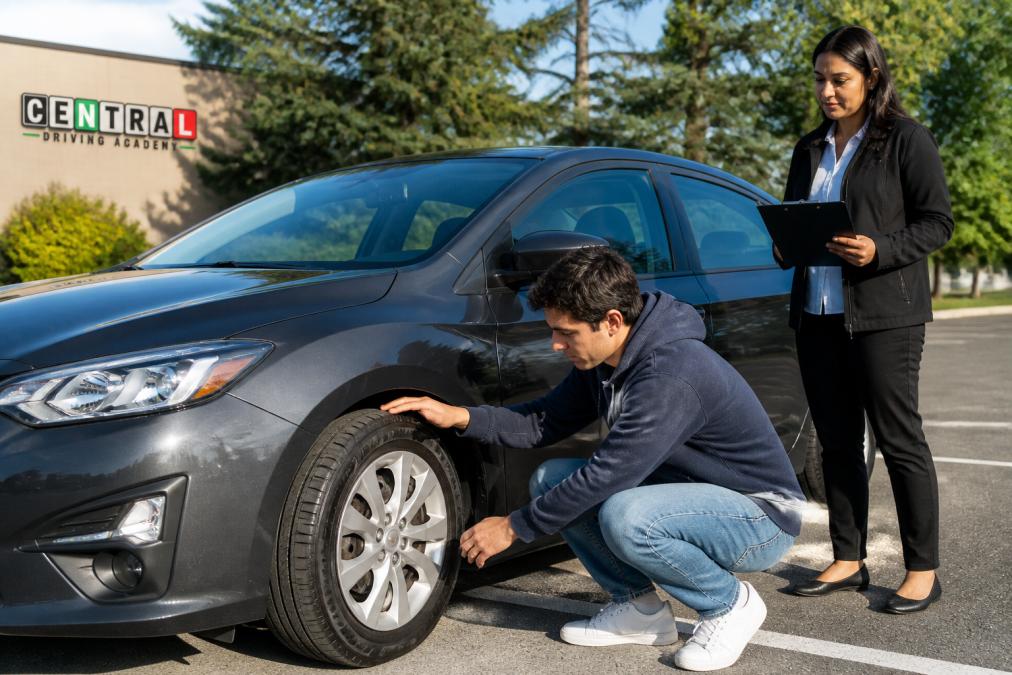
Exterior Inspection:
- All lights function: headlights (low and high beam), brake lights, turn signals, backup lights
- Windshield and windows are clean and free of cracks
- Wipers operate smoothly and clear the windshield completely
- Tires have adequate tread depth (2/32 inch minimum; 4/32 inch is safer) (Riding On Air)
- No flat spots or visible damage on tires
- License plates are secure, visible, and current
- Mirrors are clean and properly positioned
- Horn sounds clearly and distinctly
Interior Inspection:
- All seat belts lock and release properly
- Driver’s seat adjusts smoothly and locks in position
- Pedals are responsive and not sticking
- Steering wheel turns smoothly without grinding or resistance
- Dashboard warning lights are off (check engine, oil pressure, battery)
- Climate controls work if you’ll need them
- Interior is clean and free of loose items that could distract
- Rearview and side mirrors provide clear visibility
Mechanical Check:
- Engine starts smoothly without excessive cranking
- Brakes feel firm and responsive (no soft or spongy pedal)
- Transmission shifts smoothly through all gears
- No unusual noises, vibrations, or smells
- Fluid levels are adequate (coolant, brake fluid, oil)
Address any failures before test day; a burned-out bulb takes 15 minutes to replace but costs you your entire test if left unfixed.
Driving School Car Rental for Road Test
Many learners lack access to a vehicle meeting ICBC standards or prefer testing in a car they’ve practiced with extensively. An ICBC road test vehicle rental from a driving school solves both problems.
Using a driving school vehicle offers real advantages: you’ve practiced in that exact car, so controls and handling feel familiar; the car is guaranteed to meet all ICBC requirements; and there are no last-minute surprises about tire tread or warning lights.
Driving school vehicles are maintained to precise standards. Your instructor knows exactly how the brakes respond, where blind spots are, and how the steering behaves, knowledge that transfers to you during the test.
Central Driving Academy provides an ICBC road test vehicle rental as part of our comprehensive preparation program. This service is designed to eliminate variables and build confidence.
Insurance Liability and Coverage During Your Road Test
Insurance liability during your road test is critical. You need to understand who is covered, what happens if an accident occurs, and how to verify your protection before test day.
If You’re Using Your Own Vehicle
Your personal auto insurance is primary coverage during the road test. Your policy must explicitly cover you as a learner driver; most standard policies do, but some exclude learners or require a separate endorsement.
Contact your insurance provider at least two weeks before your test and confirm in writing that your policy covers you as a learner driver on your test date, covers the specific vehicle you’ll be testing in, and verify your deductible amount.
If your policy does not explicitly cover learner drivers, add a learner endorsement or use a driving school vehicle instead. Testing without confirmed coverage is a financial and legal risk.
If You’re Using a Driving School Vehicle
Driving schools carry commercial auto insurance covering learner drivers during road tests. The school’s insurance, not yours, is primary during the test.
Before booking, ask the school what insurance company covers their road test vehicles, whether coverage extends to learner drivers during ICBC road tests, and what the liability limits are. A reputable school will provide this information without hesitation.
What Happens If an Accident Occurs During Your Test
This is where the liability picture becomes complex. If an accident occurs during your road test, responsibility depends on who caused it:
Learner at fault: Your insurance (or the driving school’s insurance) covers damages. You will fail the road test, and the accident may affect your insurance rates or future licensing eligibility.
Examiner at fault: This is extremely rare. The examiner is present as an observer, not an instructor controlling the vehicle.
Third party at fault: Their insurance covers damages, though you will still fail the test if you were unable to avoid the collision through defensive driving.
An accident during your road test has cascading consequences: your insurance record is affected, you lose your test fee and appointment slot, you must wait before rebooking, and your learner’s license could be suspended if the accident involved a serious violation.
A well-maintained vehicle from a professional driving school eliminates mechanical failure as a risk factor and ensures proper insurance and inspection. You’re choosing a risk profile.
Verify Coverage Before You Book
Contact both your insurance provider and your driving school in writing to confirm coverage, and keep that confirmation. Bring proof of insurance in the vehicle on test day. This step takes 15 minutes and eliminates a major source of test-day stress and financial risk.
Booking Your Road Test Vehicle: Step-by-Step
Step 1: Schedule Your ICBC Road Test Appointment
Book your test date and time. This appointment is your anchor point.
Step 2: Confirm Vehicle Availability
If using your own car, verify it meets all ICBC requirements using the pre-trip inspection checklist. Schedule repairs immediately if any items fail.
Step 3: Book Warm-Up Lessons
Reserve 2-3 warm-up lessons in the vehicle you’ll use for the test, ideally one week before your appointment.
Step 4: Schedule a Mock Test
Schedule a full-length practice exam 3-5 days before your actual test, conducted in the same vehicle you’ll use for the real test.
Step 5: Confirm Logistics
Verify pickup location, confirm you have all required documents (learner’s license, proof of insurance, appointment confirmation), and plan to arrive 10-15 minutes early.
Last-Minute Rental Availability and Backup Options
Last-minute vehicle problems can derail months of preparation. You need a concrete backup plan before test day.
The Worst-Case Scenario: Vehicle Fails Inspection on Test Day
You arrive at the test center and your car fails inspection. The examiner will not proceed, your test is cancelled, your fee is forfeited, and you must reschedule. This is preventable with a thorough inspection one week before your test. If you discover a failure less than one week out, your options narrow significantly.
Option 1: Reschedule Your Test (Best Choice)
Contact ICBC immediately and request to move your test appointment to a later date. Explain that your vehicle has failed the pre-test inspection and you need time to repair it or arrange alternative transportation.
ICBC allows you to reschedule without penalty if you provide notice before your test time. You’ll keep your test fee and simply move to a new appointment slot.
Option 2: Borrow a Vehicle You’ve Already Practiced In
Option 3: Emergency Driving School Vehicle Rental
Option 4: Standard Car Rental Company (Last Resort)
The Prevention Strategy: Plan Three Weeks Ahead
The best backup plan is prevention. Here’s the timeline:
Three weeks before your test: Book your ICBC appointment and confirm your vehicle choice (personal car or driving school rental). If using your own vehicle, complete the full pre-trip inspection checklist immediately. If any items fail, schedule repairs now.
Frequently Asked Questions
Can I use a rental car for my ICBC road test?
Yes, you can use a rental car for your ICBC road test, but the vehicle must meet all ICBC requirements: valid registration, insurance, safety standards, and functional equipment. Many students use driving school cars specifically for this purpose because they’re already inspected and insured. If you rent from a commercial provider, confirm the vehicle meets ICBC standards and that insurance coverage extends to the road test appointment.
What documents must I provide for a rental vehicle during a road test?
You’ll need the vehicle’s registration certificate, proof of insurance, and your learner’s permit or license. The vehicle registration must be current and in the owner’s name or yours. Insurance must be valid and cover the specific vehicle. If using a driving school car, the school handles registration and insurance documentation; you provide your learner’s permit and identification.
Is insurance included when renting a car for a road test?
Insurance requirements depend on the rental source. Driving school vehicles typically include comprehensive coverage as part of their road test packages. Commercial rental agencies may require you to add coverage or provide your own. Always confirm insurance details before booking. The vehicle must have active liability and collision coverage on the road test date.
What happens if my vehicle fails the ICBC pre-trip inspection?
If your vehicle fails the pre-trip inspection, you cannot proceed with the road test that day. Common failures include burned-out lights, worn tires, missing mirrors, or non-functional wipers. You’ll need to fix the issue and reschedule your appointment. Using a driving school car eliminates this risk because instructors maintain vehicles to ICBC standards and perform inspections before each test.