Table of Contents
- Why a Driving School with a Road Test Vehicle Changes Everything
- ICBC Road Test Requirements: Vehicle and Documentation Rules
- Driving School Car Rental for Road Test: How It Works
- How to Prepare for ICBC Class 7 Road Test: A Step-by-Step Plan
- What to Look for in a Driving School with a Road Test Vehicle
- Why Learners Choose Central Driving Academy
- Frequently Asked Questions
Last Updated: September 28, 2026
Why a Driving School with a Road Test Vehicle Changes Everything
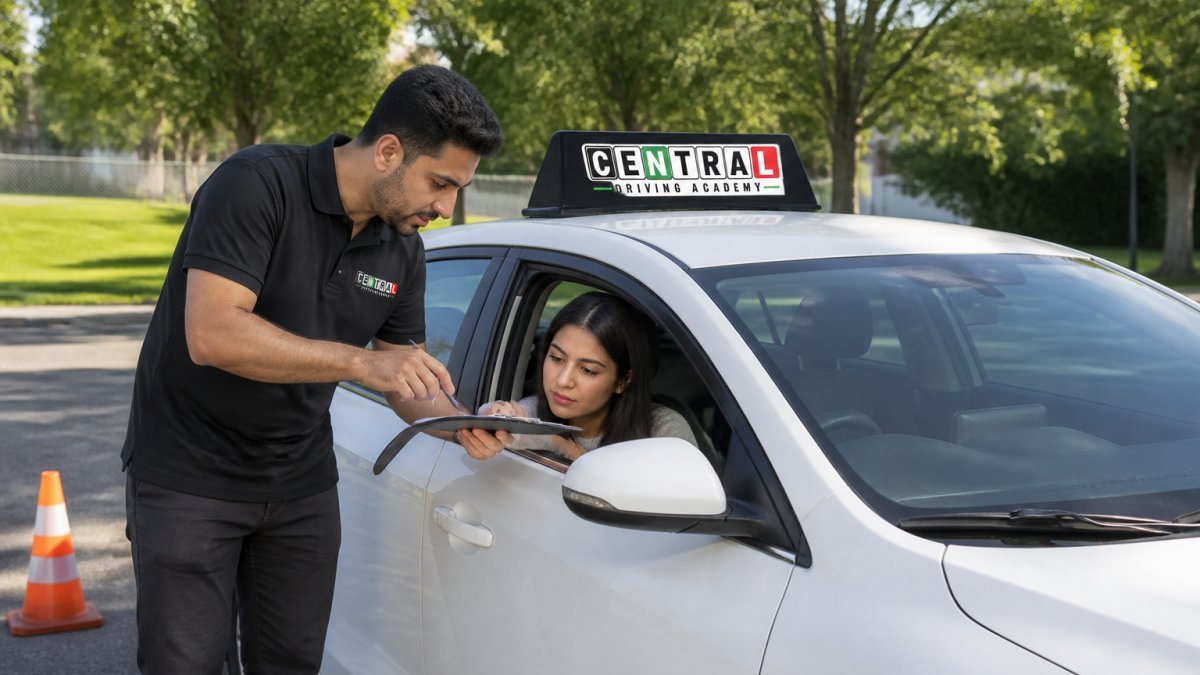
Booking a driving school with road test vehicle access removes the biggest logistical hurdle between you and your Class 7 license. Instead of scrambling for a safe, insured, ICBC-compliant car on test day, you arrive in a vehicle you already know, with an instructor who prepared you in it. At Central Driving Academy, that change settles nerves fast.
A road test vehicle from your driving school eliminates the two most common day-of failures: an uninsured car and an unfamiliar vehicle you’ve never driven.
ICBC Road Test Requirements: Vehicle and Documentation Rules
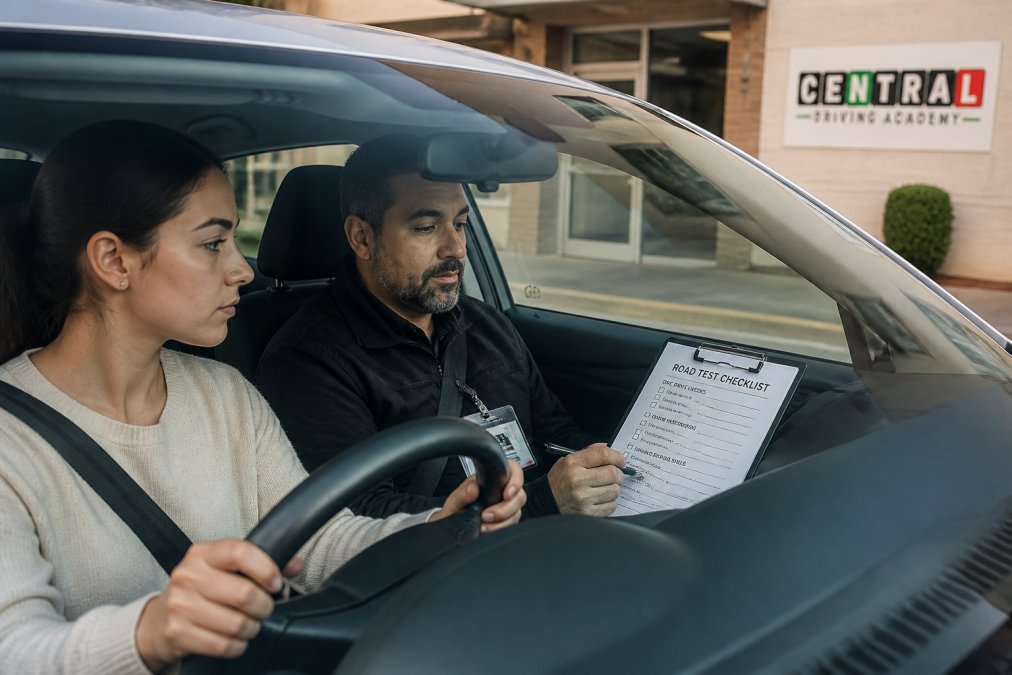
ICBC road test requirements cover what you must bring and what your vehicle must be. The examiner checks your documents and inspects the vehicle before you drive. Miss either step and the test does not proceed.
Vehicle Inspection Checklist for Your Road Test
Run through this before test day. ICBC examiners check these items, and a failure cancels your appointment. Examiners don’t just check whether a component exists, they check whether it functions correctly.
- Valid insurance and registration documents in the vehicle. The examiner will ask for the pink insurance card and registration. Both must be current and match the vehicle identification number. Photocopies are not accepted.
- Working headlights, brake lights, and turn signals. The examiner will ask you to activate each one. A single burned-out bulb fails the inspection, so check all four turn signals, both brake lights, and the high beams.
- Functional horn. The examiner will ask you to honk it. A weak or intermittent horn is a fail, commonly overlooked because drivers rarely use it.
- All mirrors present and adjustable. Both side mirrors and the rearview mirror must be intact and hold position when adjusted. A mirror that droops or vibrates is a fail.
- Tires with adequate tread and correct pressure. The examiner will visually inspect tread depth and may check pressure. The legal minimum is 1.6 mm, but examiners look for uneven wear or visible cords. Under-inflated tires are a common fail because they affect handling and braking.
- Windshield free of cracks that obstruct the driver’s view. A chip in the driver’s line of sight is a fail, as are cracks longer than a few centimeters anywhere on the windshield. Repair this before test day.
- Working windshield wipers and washer fluid. The examiner will ask you to activate the wipers and spray the washer fluid. Wipers that streak or leave gaps are a fail. Washer fluid must actually spray, not just make a noise.
- Seatbelts in working order for driver and examiner. Both must retract, latch, and lock properly. A seatbelt that does not click or retracts slowly is a fail.
- No warning lights on the dashboard. The examiner will check the instrument panel before you start the engine. An illuminated check engine, ABS, or airbag light is a fail, and a light that comes on during the test may terminate it.
- Clean interior with no obstructions. The examiner needs a clear view out all windows and a clean passenger seat. Items hanging from the mirror, dashboard clutter, or objects blocking the rear window are fails.
What Happens If Your Vehicle Fails the Inspection
If the vehicle fails, the examiner cancels the test and you lose your appointment slot, then rebook and pay again. That is the expensive outcome a driving school with road test vehicle access is designed to prevent.
If your vehicle fails inspection, you cannot simply swap to another car on the spot. The examiner will cancel the appointment and you must rebook through ICBC’s online system. In busy regions, the next available slot can be several weeks away.
The Documents You Must Bring
Beyond the vehicle, the examiner will ask for your learner’s license and a second piece of government-issued identification, a passport, provincial health card, or birth certificate. A student card or employee badge is not accepted.
A vehicle that passes inspection is not just about safety, it is about not losing your appointment slot and your test fee. A driving school with road test vehicle access handles this checklist for you, but you should still verify the car yourself the day before.
Driving School Car Rental for Road Test: How It Works
Driving school car rental for road test bookings works simply: reserve the school’s vehicle for your ICBC appointment, and it arrives insured, inspected, and ready. Most schools bundle a warm-up lesson before the test.
Insurance Liability During Road Test Rentals
Insurance liability during a road test rental sits with the driving school, not the learner, in most arrangements. The school carries commercial coverage on the vehicle, which is one reason rental pricing includes more than just the car.
Never assume a friend’s or family member’s insurance automatically covers you during an ICBC road test. If the vehicle is not properly insured for a learner driver, the examiner can refuse to proceed.
How to Prepare for ICBC Class 7 Road Test: A Step-by-Step Plan
Preparing for the ICBC Class 7 road test comes down to practice hours, mock tests, and knowing the route style near your test center. Confidence comes from repetition, not reading about driving.
- Log consistent practice hours. Spread your in-car lessons across several weeks rather than cramming them into two days. Most learners need 20 to 40 hours of supervised practice before they are test-ready, depending on prior experience.
- Book a mock road test. A full simulation with an instructor acting as examiner exposes the exact mistakes you make under pressure. Ask for a written score sheet so you can see which maneuvers cost you points.
- Drill the weak spots. Parallel parking, highway driving, and shoulder checks are the maneuvers that fail learners most often. Practice each one until it feels automatic, not just familiar.
- Drive near your test center. Familiarity with local intersections, speed limits, and school zones reduces surprises. If you can, drive the area at the same time of day as your test.
- Do a brush-up session. A short refresher the day before keeps your skills sharp without exhausting you. Avoid learning anything new the day before the test.
Booking Your Test with a Rental: A Step-by-Step Guide
Booking your test with a rental takes a few coordinated steps. Do them in the right order and the logistics take care of themselves, most guides skip how to make the two schedules actually line up.
If you are booking both the ICBC test and the school’s vehicle yourself, call the driving school first to check vehicle availability before you book the ICBC slot. Reversing the order can leave you with a test appointment and no car.
What to Do If You Need to Reschedule
If you need to reschedule your ICBC road test, you must cancel or change your appointment through ICBC’s online system or by phone. ICBC requires at least 48 hours’ notice to avoid losing your test fee. If you also reserved a driving school vehicle, call the school as soon as you know you need to change the date, most schools have their own cancellation policies, and some charge a fee for late cancellations.
Booking a road test with a rental is a two-part process: secure the ICBC slot, then secure the vehicle for that exact slot. Confirm insurance, meeting point, and warm-up lesson in writing before test day.
What to Look for in a Driving School with a Road Test Vehicle
Look for three things: ministry-approved certification, a maintained vehicle, and instructors who teach rather than intimidate. Those three factors separate a school that prepares you from one that just rents you a car.
| What to Check | Why It Matters | What to Ask |
|---|---|---|
| Instructor certification | Confirms legal, qualified teaching | Are instructors certified under the Motor Vehicle Act? |
| Vehicle condition | Prevents test-day cancellation | Is the car inspected and insured for tests? |
| Lesson format | Ensures focused feedback | Is instruction one-on-one? |
| Mock test availability | Builds test-day readiness | Do you offer full mock road tests? |
| Scheduling flexibility | Fits work or school | Can you accommodate last-minute bookings? |
Why Learners Choose Central Driving Academy
Learners choose Central Driving Academy because we handle the logistics that trip people up. Our instructors are certified under the Motor Vehicle Act, and we provide a road test vehicle so you never have to find one yourself. We serve learners across Coquitlam, Port Coquitlam, and Port Moody with bilingual instruction in English and Farsi, which matters if driving terminology in a second language has ever slowed you down.
Frequently Asked Questions
Can I use my own car for the ICBC road test?
Yes, you can use your own car for the ICBC road test if it passes the vehicle inspection. The car must be in good working order with valid insurance and registration, working lights, horn, mirrors, seatbelts, and no cracked windshield. If you are unsure whether your vehicle meets ICBC road test requirements, ask a driving school with a road test vehicle to inspect it or provide a compliant car for your test.
How much does it cost to rent a driving school car for a road test?
Pricing for driving school car rental for road test varies by school and package. Some schools include the vehicle in a test-prep package, while others charge a separate rental fee. Central Driving Academy provides a road test vehicle. Contact the school directly for current pricing and availability, and confirm what is included such as insurance, warm-up time, and pick-up.
What should I check on a vehicle before my road test?
Before your road test, check that all lights work, including brake lights, turn signals, and headlights. Test the horn, ensure windshield wipers function, and confirm the windshield has no cracks in the driver’s view. Check that tires are properly inflated and have adequate tread. Inside, verify seatbelts, mirrors, and that no warning lights are on. A driving school with a road test vehicle handles these checks for you.
Does Central Driving Academy provide a car for the road test?
Yes, Central Driving Academy provides a road test vehicle for students. The car meets ICBC road test requirements and is insured for the test. You can also book a brush-up session or mock test before your exam to practice in the same vehicle. This removes the stress of finding a compliant car and lets you focus on how to prepare for ICBC Class 7 road test.
Passing your ICBC road test depends on preparation, the right vehicle, and an instructor who actually prepares you. Central Driving Academy provides certified instructors, a road test vehicle, free in-person assessments, and bilingual instruction in English and Farsi across the Tri-Cities. Get started with Central Driving Academy and walk into your road test knowing the car, the route, and your own skills.