
Table of Contents
- Why Structured Road Test Practice Beats Random Driving
- 1. Build a Road Test Practice Checklist Around ICBC Standards
- 2. Schedule Road Test Practice With a Supervisor Who Gives Real Feedback
- 3. Master Parallel Parking Practice for Road Test Day
- 4. Practice in Varied Conditions and Real Traffic Scenarios
- 5. How Often Should I Practice Before a Road Test?
- Test-Day Logistics and Vehicle Eligibility
- Frequently Asked Questions
Last Updated: October 12, 2026
Why Structured Road Test Practice Beats Random Driving
Most learners fail the road test not because they can’t drive, but because they never practiced the right things. Random driving builds bad habits. Structured road test practice builds the exact skills an examiner scores. Most learners walk into their ICBC Class 5 test unprepared, then wonder why they failed. The fix is simple: practice with a plan, not by feel.
Road test practice is the deliberate, repeated rehearsal of the specific driving behaviors an examiner evaluates, including observation, vehicle control, and decision-making under real traffic conditions. It differs from casual driving because every session targets a measurable skill.
Below, we break down the 5 best ways to practice for your road test, with a checklist, a supervisor strategy, a parking routine, and a week-by-week schedule you can start today.
The ICBC driving test guide outlines exactly what examiners score. That document is your blueprint.
Random practice builds comfort. Structured practice builds passes. Every session should target one examinable skill: mirror checks, shoulder checks, speed control, or a specific maneuver.
1. Build a Road Test Practice Checklist Around ICBC Standards
A road test practice checklist turns vague goals into scored skills. Start by listing every skill ICBC evaluates, then rate yourself on each one after every drive.
What to Include in Your Checklist
- Mirror checks before every turn and lane change
- Shoulder checks into the blind spot
- Smooth braking and acceleration
- Correct speed limit adherence in school zones and residential streets
- Proper following distance
- Complete stops at intersections
- Signaling before every maneuver
- Parallel parking within the marked space
- Backing up with full observation
Tracking Progress Week by Week
Score each item 1 to 5 after every practice drive. Anything below a 4 needs work next session. This turns “I think I’m ready” into “I’m scoring 5 on everything except parallel parking.”
Learners who skip the checklist often repeat the same mistake for weeks without noticing. That mistake becomes a habit, and habits are hard to break before test day.
2. Schedule Road Test Practice With a Supervisor Who Gives Real Feedback
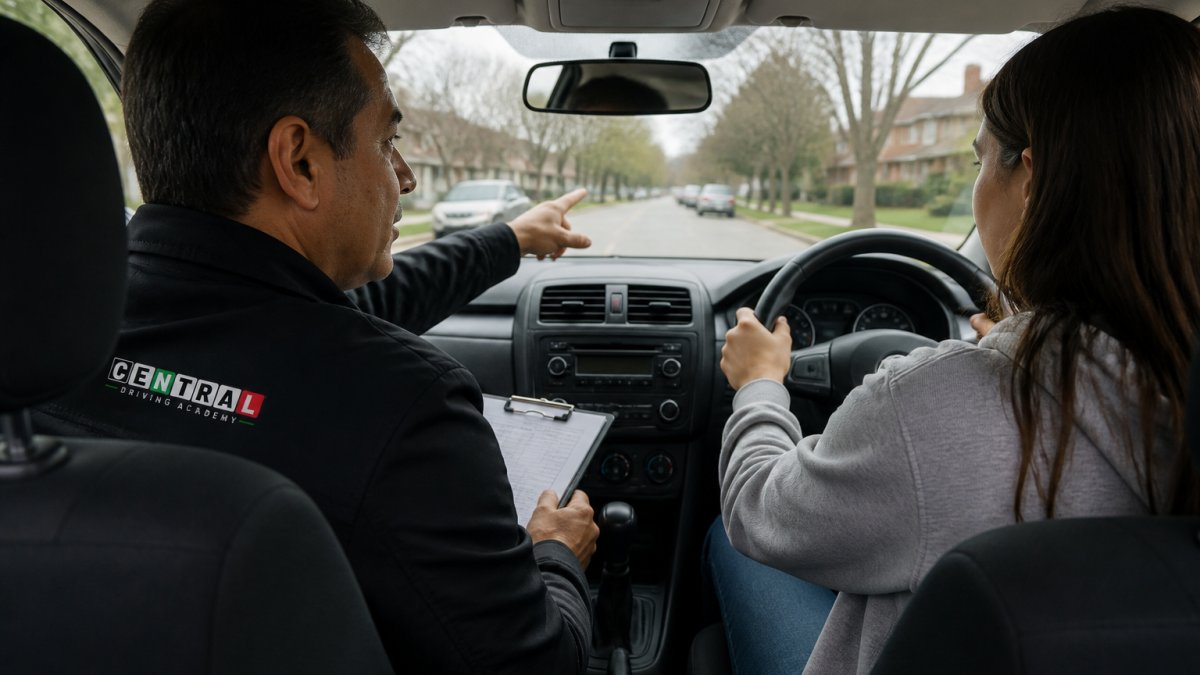
The right supervisor changes everything. A good one spots errors in real time and explains the fix. A bad one just says “you did fine.” The difference shows up on test day as points you never knew you were losing.
How to Choose the Right Practice Supervisor
Most learners pick whoever is available. That is the wrong filter. Use these criteria instead:
- Licence history and recency. A supervisor should have held a full licence for several years and still drive regularly. Someone who passed decades ago and drives twice a month will not recognize current examiner expectations.
- Calm communication under stress. Watch how they react when you make a mistake. If they raise their voice or grab the wheel, they will make you more anxious, not more skilled.
- Ability to explain the why. “Signal earlier” is not coaching. “Signal before the intersection so pedestrians and cross-traffic see your intent” is coaching.
- Familiarity with current scoring. Standards change. A supervisor who knows the current ICBC scoring sheet will catch deductions a well-meaning parent will miss.
- Willingness to stay quiet. Good coaches let you make small errors and debrief afterward, so you build independent judgment instead of waiting for prompts.
A certified driving instructor is the safest choice because they combine all five. Our team at Central Driving Academy is certified under the Motor Vehicle Act, and we build every lesson around the exact skills examiners score.
Getting Useful Feedback During Solo Practice
Solo driving still counts, but you need a system to catch your own errors. Without one, you rehearse mistakes until they feel normal. Try these methods:
- Narrate your observations out loud. Say “mirror, signal, shoulder check” before every maneuver. If you cannot narrate it, you probably did not do it.
- Use a post-drive log. After each session, write down three things: one skill that improved, one mistake you repeated, and one thing to focus on next time. Review the log before your next drive.
- Record short videos of parking attempts. A phone propped on a dashboard or a passenger filming from outside shows you exactly where your geometry breaks down.
- Run a self-scored checklist. Rate each examinable skill 1 to 5 immediately after the drive, while the details are fresh.
- Book a periodic professional assessment. Even one or two lessons with a certified instructor can surface habits a friend or family member would never notice.
This is where most learners fall short. They practice alone, feel confident, then lose points on observation habits they never noticed. A feedback loop, whether from a coach, a log, or a video, is what turns practice into progress.
Ask your supervisor to score you using the same categories the examiner uses. When your practice scores match the official scoring sheet, there are no surprises on test day.
3. Master Parallel Parking Practice for Road Test Day
Parallel parking fails more learners than any other maneuver. The fix is repetition with a fixed routine, not luck.
Step-by-Step Parallel Parking Routine
- Pull alongside the front car, about one meter away
- Stop when your rear bumper aligns with theirs
- Reverse slowly while steering fully toward the curb
- Straighten the wheel once you see the rear car’s plate
- Continue reversing while steering away from the curb
- Straighten, check your spacing, and stop
Practice this exact sequence ten times in a row. Then practice it on a different street. Consistency under pressure is the goal.
Set up two cones or laundry baskets in an empty lot to mimic parked cars. Practicing the same geometry repeatedly builds muscle memory faster than real streets allow.
4. Practice in Varied Conditions and Real Traffic Scenarios
Driving the same quiet loop every day teaches you one thing: that loop. The road test throws variety at you, and examiners deliberately route you through conditions that expose whether your skills transfer.
Build a Conditions Progression
Do not jump straight into a downpour on a highway. Add one variable at a time so each new condition builds on a skill you already own.
- Familiar roads, clear weather. Establish baseline control: smooth braking, mirror rhythm, lane position.
- Familiar roads, light rain. Learn how wipers, defoggers, and reduced visibility change your scan pattern.
- Unfamiliar residential areas, clear weather. Practice reading new intersections, hidden driveways, and parked-car blind spots.
- Busy arterials at off-peak times. Add lane changes, merge decisions, and following distance under pressure.
- Busy arterials at peak times. Add pedestrians, cyclists, transit stops, and impatient drivers.
- Highway on-ramps and merges, clear weather. Practice matching speed to traffic and choosing a gap.
- Night driving on familiar roads. Headlight glare, reduced depth perception, and lower visibility change every judgment.
- Rain at night or in heavy traffic. Only attempt this once the earlier steps feel routine.
What Each Condition Actually Changes
- Rain. Stopping distances lengthen and painted lines become harder to see. Increase following distance beyond the normal gap and brake earlier and more gently.
- Darkness. Your effective scan distance shrinks. Slow down enough that you can stop within the distance your headlights actually illuminate.
- Busy traffic. Gaps close faster. Shoulder checks and mirror checks need to happen earlier so you are not deciding at the last second.
- Unfamiliar areas. You cannot rely on memory. Read street signs, lane markings, and intersection geometry deliberately rather than by habit.
- School and playground zones. Timing matters. Practicing during pickup and drop-off hours teaches you to scan between parked cars for children.
Safety Rules for Practicing in Hard Conditions
- Never practice a new condition alone if you have not yet mastered it in easier conditions.
- Keep sessions short. Fatigue in rain or at night sets in faster than in daylight.
- If visibility drops below what you can safely manage, pull over and wait. No practice session is worth a collision.
- Debrief after every session. Note which condition exposed the biggest weakness and schedule that condition again next week.
Hazard awareness and defensive driving improve fastest when conditions are less than perfect. If you have only driven in sunshine on empty roads, your first rainy test day will feel foreign. Building the progression above means no condition on test day is truly new.
Do not treat a single successful drive in rain or at night as mastery. Repeat each new condition at least twice before moving to the next step in the progression.
5. How Often Should I Practice Before a Road Test?
Practice four to five times per week for at least four weeks before your test. Short, focused sessions beat one long weekend cram.
A Sample 4-Week Practice Schedule
| Week | Focus | Sessions | Goal |
|---|---|---|---|
| 1 | Vehicle control and observation | 4 | Smooth steering, braking, mirror checks |
| 2 | Turns, lane changes, intersections | 4 | Correct signaling and right of way |
| 3 | Parking and backing maneuvers | 5 | Parallel parking scored 5/5 |
| 4 | Full mock tests in traffic | 4 | Complete a clean test route |
Track each session against your checklist. If a skill slips below a 4, repeat that week’s focus.
Test-Day Logistics and Vehicle Eligibility
Your practice only counts if your test vehicle passes inspection. ICBC requires a valid insurance document, working lights, signals, horn, brakes, and mirrors. A cracked windshield or worn tire can end your test before it starts.
Do a pre-trip inspection the day before. Check every light, the horn, and your tire tread. If you don’t own a test-ready car, ask about a road test vehicle when you book.
Central Driving Academy provides a road test vehicle and offers free in-person assessments, so you know exactly where you stand before test day.
Frequently Asked Questions
How often should I practice before a road test?
Aim for three to four practice drives per week for at least four weeks before your test. Each session should run 45 to 60 minutes and focus on a specific skill, such as observation or parking. If you are a complete beginner, start earlier and build up gradually. Consistency matters more than long marathon sessions because repetition helps you internalize mirror checks, shoulder checks, and speed control until they become automatic.
What should I focus on during a practice drive?
Prioritize observation habits first: mirror checks every five to eight seconds, shoulder checks before every lane change, and scanning intersections before entering. Then work on speed control and following distance. Use a road test practice checklist to track which skills you have mastered and which still need work. Rotate through turns, lane changes, parking, and residential street driving so no single area gets neglected.
Should I take a driving lesson before my road test?
A pre-test lesson with a certified instructor gives you an objective assessment of your habits and highlights mistakes you may not notice on your own. Instructors familiar with ICBC standards can point out test deductions you are likely to trigger, such as incomplete stops or late signaling. One or two focused lessons before test day often make the difference between a first-time pass and a retest.
What mistakes should I avoid during a road test?
The most common deductions include rolling through stop signs, missing shoulder checks, driving too slowly, and failing to scan intersections. Nervousness can cause you to grip the wheel too tightly or forget mirror checks. Practice under mild pressure by having a supervisor stay silent while you drive a familiar route, then review what you missed. Build a consistent pre-drive routine so vehicle checks and seat adjustment become second nature.
Passing the road test takes more than seat time. It takes a plan, honest feedback, and practice that mirrors the real exam. Central Driving Academy builds all three into every lesson, with certified instructors under the Motor Vehicle Act, bilingual instruction in English and Farsi, and flexible six-day scheduling with pick-up and drop-off. Book your free assessment with Central Driving Academy and walk into your ICBC road test ready.