Quick Summary
To find certified driving instructors in BC, first confirm the school is ICBC certified, then verify each instructor’s own licence number and expiry date against official records. Ask for proof of insurance and a criminal record check, and treat any unverifiable credential as a warning sign.
- Confirm the school’s certification and business licence number before anything else.
- Certifying a school does not automatically certify each instructor, so check individuals separately.
- Ask each instructor for their licence number, issuing regulator, expiry date, and proof of insurance.
- Check credentials against the regulator’s public register or call its licensing line to confirm.
- Walk away from any instructor who guarantees a road test pass or demands large payment up front.
Table of Contents
- Why Instructor Certification Matters for New Drivers
- Step 1: Check That the School Is ICBC Certified
- Step 2: Verify Each Instructor’s Credentials
- Step 3: Look for Red Flags of Uncertified Instructors
- Step 4: Ask the Right Questions Before You Book
- Step 5: Compare Driving Lesson Pricing Without Sacrificing Quality
- Step 6: Plan Your Lessons Around Your Road Test
- Booking Your First Lesson With Central Driving Academy
- Frequently Asked Questions
Why Instructor Certification Matters for New Drivers
Certification is the first thing families should check when choosing among certified driving instructors. A certified instructor has met the standards set for teaching driving in British Columbia, and that matters when a learner’s safety is on the line.
Certification gives you a baseline. It does not guarantee a great experience, but it filters out people who have not met the basic requirements to teach. Start there, then look at fit, patience, and communication.
Step 1: Check That the School Is ICBC Certified
Start by confirming the school holds the right approval to provide driver training in B.C. If you want a curated shortlist, see the best driving schools in Coquitlam for beginners. Look for clear statements of certification on the school’s website and in its paperwork, and ask for the details directly if they are missing. To see how a Coquitlam driving school is chosen and whether it fits your needs, read how to choose a driving school in Coquitlam.
- Ask for the school’s name, business licence number, and certification status
- Confirm the school offers lessons that match your licence stage
- Check that the instructor names on the website match the people who will teach you
A school that is open about its credentials will answer these questions without hesitation. Treat hesitation as a warning sign.
Step 2: Verify Each Instructor’s Credentials
Certifying a school does not automatically mean every instructor is qualified. In most provinces the school holds the business approval while each instructor holds an individual licence or permit, and those are two separate things to confirm before you rely on certified driving instructors. Ask each instructor to show proof of their own credentials, and keep a record of what they provide. For guidance on finding patient, qualified instructors to contact, see how to find patient driving instructors.
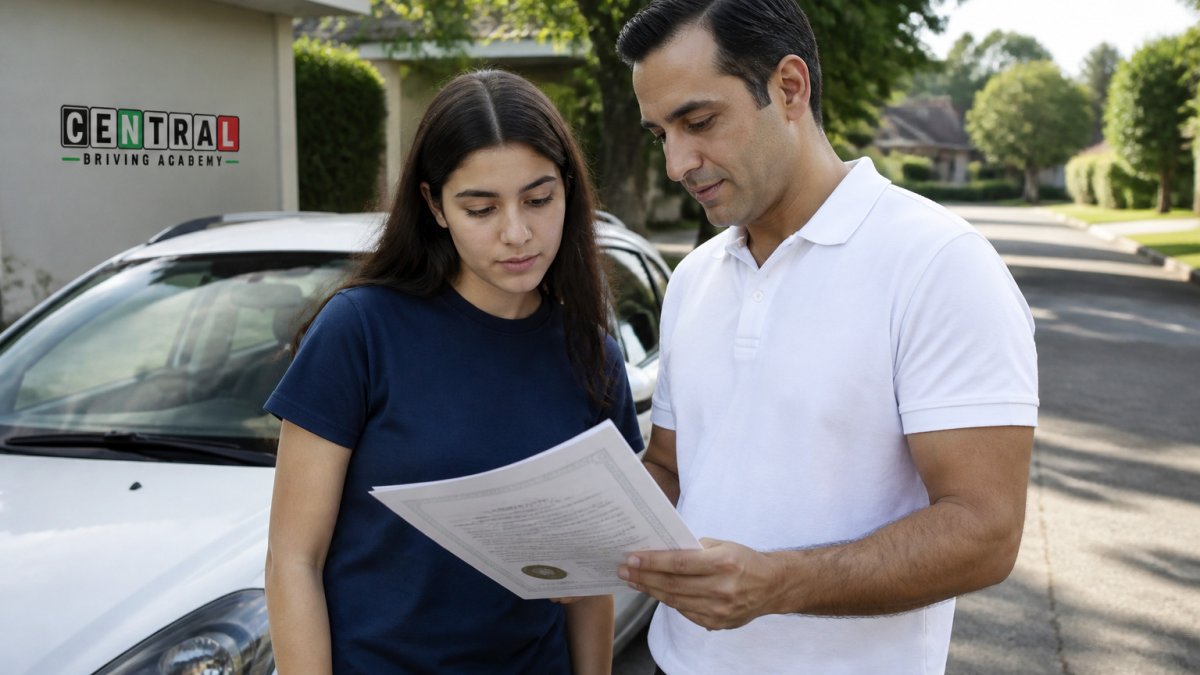
A young learner and a calm instructor reviewing a certificate beside a parked car is a good picture of this step in practice.
!A young learner and a calm, professional instructor reviewing a printed certificate together beside a parked car on a quiet residential street in daylight
What to ask for
A legitimate instructor should be able to produce, without hesitation:
- Their instructor licence or permit number, and the expiry date on it
- The name of the regulator or agency that issued it
- Proof of a current criminal record check, if your province requires one for instructors
- Proof of commercial insurance covering the vehicle used for lessons
- The school’s business licence or registration number
Write down the licence number and expiry date. A credential you cannot confirm through an official channel should be treated as unverified until you can check it.
How to confirm it through official channels
Most provinces publish a public register, licensee list, or searchable database where you can confirm that a driving school or instructor is currently approved. The exact tool varies by province: some regulators post a downloadable list of licensed schools, others offer an online lookup, and some direct you to call the licensing office directly. Search for your provincial regulator’s driving-school or instructor-licensing page, then use the lookup or contact details it provides. If no public lookup exists, call the regulator’s licensing line and ask them to confirm the instructor’s name and licence number.
Before your first lesson, spend five minutes confirming the instructor’s licence number against the regulator’s list. It is the single fastest way to separate a certified instructor from someone teaching informally.
You can also review the provincial driver training rules through the [Insurance Corporation of British Columbia (ICBC) driver licensing resources | icbc.com]. The [Motor Vehicle Act | bclaws.gov.bc.ca] sets out the legal framework behind provincial driver training (Motor Vehicle Act Regulations).
If the instructor cannot be verified
If the instructor cannot produce a licence number, gives a number that does not match the regulator’s records, or says the school handles all licensing and they personally have none, treat that as unverified. Ask the school to confirm in writing which licensed instructor will actually be in the car with you. A school that cannot answer that question clearly is not one to book with.
Before you rely on an instructor, check these credentials, which the article lists as items to request and confirm.
| Credential | What to check | Why it matters |
|---|---|---|
| Instructor licence or permit | Number and expiry date | Confirms the individual is approved to teach |
| Issuing regulator | Name of the agency | Lets you verify the licence |
| Criminal record check | Proof of current check | Required in some provinces |
| Commercial insurance | Covers the lesson vehicle | Protects you during lessons |
| School business licence | Registration number | Confirms the school is registered |
Step 3: Look for Red Flags of Uncertified Instructors
Some warning signs show up again and again with unlicensed or uncertified instructors. Spotting them early saves time and money, and it protects you from lessons that do not count toward your licensing requirements.
Licensing and paperwork red flags
- No written proof of certification when you ask for it, or a licence number that does not match the regulator’s records
- A licence or permit that has expired, or that names a different person than the one teaching you
- Refusal to show a criminal record check when your province requires one
- No business licence, no contract, and no receipt
- Cash-only payment with no paper trail
Insurance and vehicle red flags
- Vague answers about insurance, or no clear statement of who covers a student during a lesson
- Lessons offered in a personal vehicle with no sign of a registered school, no dual-brake setup where required, and no school markings
- A vehicle that would not pass a road test inspection, or that lacks the safety equipment your province requires for instruction
Teaching and sales red flags
- Promises of guaranteed test passes, or claims that a specific examiner can be requested
- Pressure to pay for a large package up front before you have had a single lesson
- No structured lesson plan, and no explanation of how progress will be tracked
- An instructor who will not let a parent or guardian observe, or who insists on one-on-one lessons only with no written policy
- Frequent last-minute cancellations with no rescheduling policy in writing
Any one of these is worth a closer look. Several together are a reason to walk away.
A guaranteed pass is the clearest red flag in the industry. No legitimate instructor can promise an outcome on a government road test, and anyone who does is either misrepresenting the process or planning to cut corners on your training.
Questions to ask before you book
A short conversation before booking tells you more than any website. Ask these questions and listen for specific, calm answers:
- What is your instructor licence number, and which regulator issued it?
- How many years have you taught new drivers, and how many students have you taken to a road test?
- What is your approach with nervous or anxious students?
- How do you handle a student who makes a serious mistake during a lesson?
- Can you walk me through how a typical lesson is structured, from pick-up to drop-off?
- What does your insurance cover, and who is liable if something happens during a lesson?
- What is your cancellation and rescheduling policy, in writing?
- Do you provide the test vehicle, and does it meet the requirements for the road test?
- How do you track progress, and how will I know when I am ready to book the test?
- Can I speak with a recent student as a reference?
Pay attention to how the instructor answers, not just what they say. Calm, specific answers with names, numbers, and written policies are a strong sign. Vague or defensive answers are not.
Step 4: Ask the Right Questions Before You Book
A short conversation before booking tells you more than any website. These questions help you judge whether an instructor is a good match.
- How many years have you taught new drivers?
- What is your approach with nervous or anxious students?
- How do you handle a student who makes a serious mistake?
- Can you explain how a lesson will be structured?
- What happens if a lesson has to be rescheduled?
Pay attention to how the instructor answers, not just what they say. Calm, specific answers are a strong sign.
Step 5: Compare Driving Lesson Pricing Without Sacrificing Quality
Lesson pricing varies, and the lowest price is not always the best value. If you are weighing cost against quality, read how to decide if driving school is worth it. Pricing depends on package size, vehicle type, pick-up location, and the level of instruction. Check what each quote includes before comparing numbers, and ask for current rates directly from each school. To see affordable lesson options in Coquitlam that keep quality high, explore affordable driving lessons in Coquitlam.
Look for these items in any quote:
- Whether the instructor is certified and insured
- Whether the vehicle is provided, and whether it meets test requirements
- Whether pick-up and drop-off are included
- Whether a road test is covered and how rescheduling works
Visit the Central Driving Academy website or contact our team for current pricing and a quote tailored to your needs.
Step 6: Plan Your Lessons Around Your Road Test
Plan your lessons backward from your road test date. Build in time for practice between sessions, and leave room to reschedule if you need it.
A practical plan looks like this:
- Book an initial assessment to identify your current skill level
- Schedule regular lessons so skills build week by week
- Add focused sessions on the areas your instructor flags
- Book a mock road test close to your actual test date
- Confirm test logistics, including the vehicle and documents you need
Preparation for the [ICBC road test | icbc.com] goes better when lessons match the test standards.
Booking Your First Lesson With Central Driving Academy
Central Driving Academy offers bilingual instruction in English and Farsi, flexible six-day availability, and pick-up and drop-off at your location. A free in-person assessment and a road test vehicle are part of our service.
Ready to get started? Book a lesson with Central Driving Academy and take your first confident step behind the wheel.
Frequently Asked Questions
How do I verify if a driving instructor is certified?
Start by asking the school for the instructor’s full name and certification details, then confirm the school is ICBC certified through ICBC’s official listings. A legitimate instructor will show you a current certificate without hesitation. If the school or instructor avoids giving clear credential information, treat that as a warning sign and continue your search with another provider.
What qualifications should a professional driving instructor have?
A professional instructor should hold a valid driver’s licence with a clean record, complete the required instructor training under British Columbia’s driver education framework, and work for a school that operates under the Motor Vehicle Act. Ask whether they have experience teaching beginners, nervous learners or students preparing for the ICBC road test, since those skills differ from general driving ability.
Why is it important to choose an ICBC-certified driving school?
ICBC certified driving schools follow provincial standards for lesson content and instructor qualifications. Lessons from a certified school count toward the training your ICBC process expects, and your certificate of completion carries recognized weight. Uncertified lessons may not be accepted, which can mean paying twice for the same hours.
How long is a typical driving lesson?
Most behind-the-wheel lessons run between one and two hours, with shorter sessions suitable for nervous beginners who need time to build confidence. Lesson length depends on the learner’s experience and goals. You can confirm current scheduling options directly with the school when you book.
