Last Updated: November 2, 2026
Quick Summary
An advanced defensive driving course teaches experienced drivers to anticipate hazards before they happen, focusing on decision-making rather than basic vehicle control. When choosing one, compare the format, the number of in-car hours included, and the instructor’s qualifications and credibility.
- Compare course format, duration and delivery before booking.
- Divide the total package price by in-car hours to get a true per-hour cost.
- Ask whether assessment time is counted in your hours or added on top.
- Verify instructor certification and ask for it in writing before paying a deposit.
- Choose a basic lesson program first if you still find shifting, merging or intersections difficult.
Table of Contents
- What an Advanced Defensive Driving Course Covers
- Who Should Take an Advanced Course and Who Should Start With Basics
- Step 1: Compare Course Formats, Duration and Delivery
- Step 2: Check What Is Included and How Pricing Works
- Step 3: Verify Instructor Qualifications and Course Credibility
- Defensive Driving Techniques and Hazard Perception Practice in Real Traffic
- Booking Your Advanced Course and Practising What You Learn
- Frequently Asked Questions
What an Advanced Defensive Driving Course Covers
An advanced defensive driving course teaches experienced drivers to anticipate danger before it happens. Unlike a basic licensing course, it focuses on decision-making under pressure, not just vehicle control.
Defensive driving is the practice of staying alert to what other drivers might do and having a plan for it. The Insurance Corporation of British Columbia (ICBC) publishes road safety resources that cover many of these habits, and a good course builds on them. ICBC road safety and driving tips
Most courses cover three core areas: hazard recognition, vehicle control, and risk reduction. Each one builds on the last.
Hazard Awareness and Collision Avoidance
Hazard awareness is the habit of scanning the road continuously, not just watching the car ahead. Collision avoidance comes from acting on those observations early, often by adjusting speed or following distance before a problem develops.
A common mistake is following too closely. Experienced drivers often keep a gap that feels generous but is still too short for sudden braking.
Emergency Braking, Skid Recovery and Evasive Steering
These skills are practised in controlled settings before they are used on public roads. Emergency braking teaches drivers to brake hard and steer at the same time when the situation calls for it. Skid recovery shows what to do when a vehicle loses traction, usually by easing off the accelerator and steering in the direction the car is pointing. Evasive steering covers swerving around an obstacle when braking alone will not stop the vehicle in time.
Who Should Take an Advanced Course and Who Should Start With Basics
An advanced course suits drivers who already hold a licence and drive regularly. Typical candidates include commuters on busy highways, drivers who have had a collision or near miss, and older drivers who want to sharpen their habits. The course assumes you already know how to operate a vehicle safely.
Drivers who are still new to the road should start with a basic lesson program. If you are learning to shift, merge, or handle an intersection with confidence, an advanced course will move too quickly. Building those fundamentals first makes the advanced material far more useful.
We suggest a simple test: if you can drive comfortably in heavy traffic but feel uneasy about sudden hazards, an advanced course is a strong next step.
Step 1: Compare Course Formats, Duration and Delivery
Start by deciding how you want to learn. Advanced courses are often offered in different formats, so it helps to ask a provider what it includes.
Consider how much time you can commit and whether you prefer intensive or gradual learning. If you are comparing schools in your area, see how to choose a driving school in Coquitlam for guidance on evaluating local providers.
Delivery also matters. Ask whether lessons happen in a dual-control vehicle, whether pick-up and drop-off is offered, and whether scheduling can accommodate a busy routine.
Match the format to your goals. Compare the options in the BC driver licensing requirements to confirm any course credit or licensing implications before you book.
For a deeper look at how these formats differ, read our guide on private driving lessons vs group classes in Coquitlam.
Step 2: Check What Is Included and How Pricing Works
Price is the question most students ask first, and it is the one most course pages answer least clearly. Before you compare quotes, separate what you are actually buying into four line items: in-car instruction hours, assessment time, vehicle use for a road test, and any classroom or online theory component. A course that bundles all four can cost more per hour than a bare in-car package but deliver better value once you account for the extras.
Pricing depends on the course format, the number of lessons, and the scheduling and pick-up arrangements. For current prices and a breakdown of what each package includes, contact Central Driving Academy for a quote.
When you compare providers, ask these questions and write the answers down side by side:
- How many hours of in-car instruction are included, and is the assessment hour counted against that total or added on top?
- Is a dual-control vehicle provided for the road test, and is there a separate fee or deposit for it?
- Are pick-up and drop-off included, or charged by distance or zone?
- What are the cancellation and rescheduling terms, and how much notice is required to avoid a charge?
- Is the initial assessment or consultation free, and does it produce a written plan?
- Are taxes included in the quoted figure, and is a deposit required to hold a booking?
A lower headline price can hide fewer hours, a shorter lesson, or an extra charge for the test vehicle. Divide the total package price by the number of in-car hours to get a true per-hour figure, then compare that number across providers rather than the package total.
Ask for the quote in writing with the hour count and inclusions listed. A provider that will not put the breakdown in writing is telling you something about how the course is run.
You can also review affordable driving lesson options in Coquitlam to see how local programs are structured, and check whether any package you are considering aligns with the licensing context described in the BC driver licensing requirements before you commit.
Before comparing quotes, it helps to check exactly what each package covers and how the price is built up.
| Item | What to check | Why it matters |
|---|---|---|
| In-car instruction | Hours included | Divide total price by hours for a true per-hour cost |
| Assessment time | Counted in hours or added on | Affects the real number of lessons you receive |
| Road test vehicle | Dual-control vehicle fee or deposit | Can add cost not shown in headline price |
| Pick-up and drop-off | Included or charged by zone | Changes the total you pay |
| Cancellation terms | Notice period and charges | Protects you if your schedule changes |
| Taxes and deposit | Included in quote, deposit required | Determines the final amount and booking hold |
Step 3: Verify Instructor Qualifications and Course Credibility
Credibility is the most important factor in choosing a course, and it is also the easiest to fake with a polished website. The fix is to verify rather than trust. Work through the checklist below before you pay a deposit, and ask for documentation where it applies.
Instructor credentials. Confirm the instructor is certified to teach in the province and ask what that certification required. Ask how many years the instructor has been teaching, not just driving, and whether they specialize in advanced or defensive work rather than only beginner licensing preparation.
Vehicle safety and insurance. Ask whether the training vehicle is dual-control and what insurance covers the student while driving. A school that cannot answer these questions plainly is a risk you do not need to take.
Course structure and outcomes. A credible provider can describe the curriculum in sequence: what is taught in session one, how progress is measured, and what a student should be able to do by the final session. Ask what proportion of instruction is in-car versus classroom, and whether there is a written debrief or progress note after each lesson.
Reviews, read properly. Reviews are a useful signal, but read them for specifics. Look for comments about instructor patience, clarity of instruction, punctuality, and results, not just general praise. Central Driving Academy has 45 reviews on Google. One student, Jordan Wong, wrote that the instructor was “very professional, knowledgeable and was a great teacher.” Weight reviews that describe a named instructor and a specific outcome more heavily than short five-star lines.
Standing and accountability. Check that the school operates in line with provincial requirements. Our instructors are certified under the Motor Vehicle Act. For guidance on confirming a driver training provider, see how to find certified driving instructors in BC.
A certificate or badge on a website is not verification. Ask to see the credential, confirm the instructor’s name matches the one who will teach you, and get the insurance and vehicle details in writing before your first lesson.
Defensive Driving Techniques and Hazard Perception Practice in Real Traffic
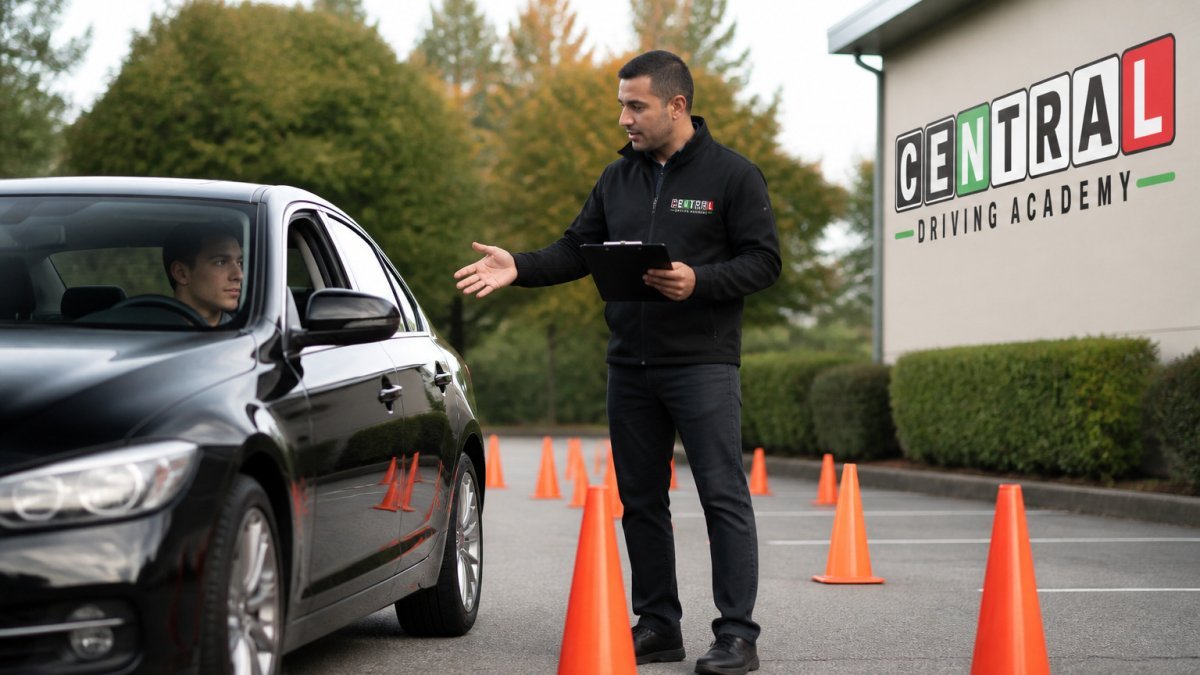
Classroom learning only goes so far. The real test of defensive driving is how you respond on live roads with other vehicles, pedestrians, and changing conditions. Good instructors build practice sessions around varied traffic, including busy intersections, multi-lane roads, and areas with frequent cyclists.
Hazard perception practice trains you to notice problems earlier. Your instructor may ask you to narrate what you see, which helps build the habit of scanning. Over time, this becomes automatic. Many drivers find that the biggest improvement comes from simply looking further ahead and checking mirrors more often.
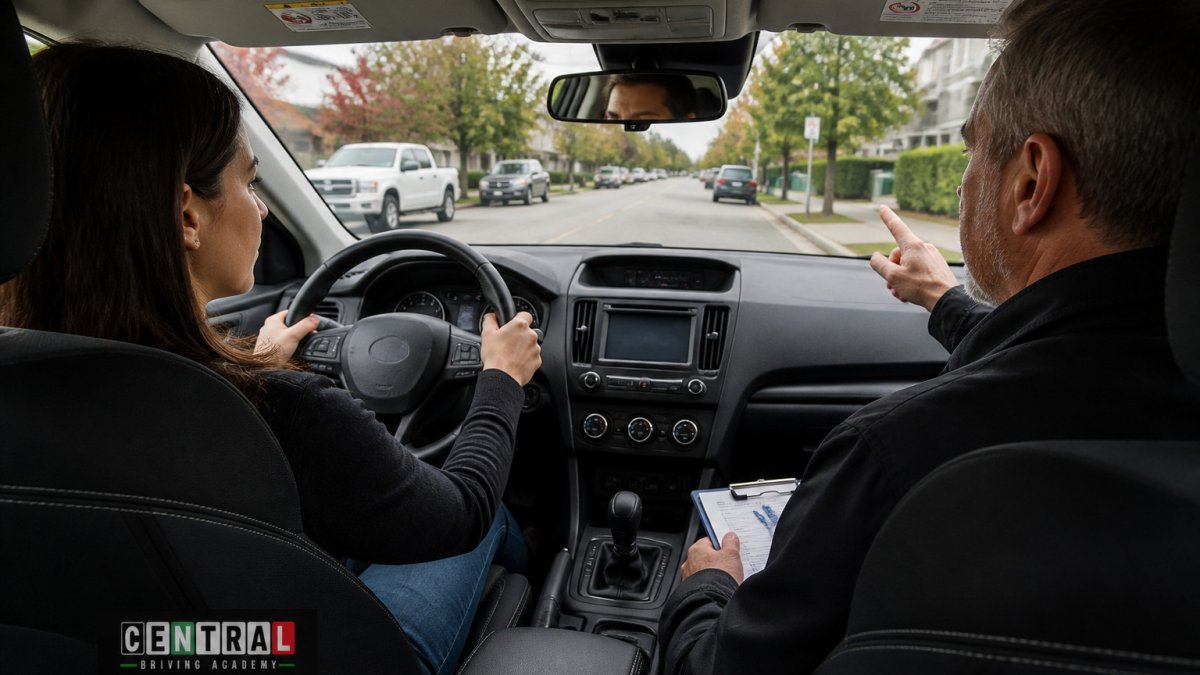
Practice in a real environment is what makes these habits stick.
Booking Your Advanced Course and Practising What You Learn
Once you have chosen a provider, booking is usually simple. Contact the school, confirm your preferred format and schedule, and ask about any assessment or road test arrangements. Central Driving Academy offers a free in-person assessment.
Practice between sessions matters too. Try applying one new habit each drive, such as checking your following distance or scanning intersections earlier. Small, consistent efforts build lasting skills.
If you are ready to get started, Central Driving Academy welcomes new students who want to build confidence on the road. Book now to take the next step toward safer, more assured driving.
Frequently Asked Questions
What is covered in an advanced defensive driving course?
An advanced defensive driving course builds on basic licensing skills and focuses on anticipating hazards before they become emergencies. Good providers explain the curriculum before you enrol and tell you how much time is spent on in-car practice versus classroom instruction. Ask for a written outline so you can compare courses on content rather than marketing language. Central Driving Academy offers advanced defensive driving instruction and can provide current course details on request.
Who should take advanced defensive driving lessons?
Advanced defensive driving suits newly licensed drivers who want more control in difficult conditions, experienced drivers who have never had formal training, and drivers who feel uneasy on highways or in heavy traffic. Nervous drivers often benefit from patient instruction that builds confidence step by step. Learners who have not yet passed their road test should usually complete foundational lessons first. A short conversation with an instructor can confirm which level fits your current skills and goals.
How do I choose a driving instructor for advanced training?
Start by confirming the instructor holds the credentials required under British Columbia’s Motor Vehicle Act. Ask how long they have taught, whether lessons can be delivered in your first language, and how they handle nervous or anxious students. Check recent reviews, and ask whether the first session includes an assessment of your current skills. A reputable instructor will answer these questions directly and without pressure.
Are advanced defensive driving courses available in Coquitlam?
Yes. Central Driving Academy provides professional driver education across Coquitlam, Port Coquitlam and Port Moody, including advanced defensive driving training. Lessons can include pick-up and drop-off, and a free in-person assessment is available before you commit. For current availability, schedules and pricing, contact Central Driving Academy directly, since pricing depends on the course format and the number of lessons you choose.
