
Table of Contents
- Understanding What the Road Test Evaluates
- How to Prepare Before Test Day
- Building Your Adult Driving Lessons Foundation
- Essential Practice Driving Skills and Maneuvers
- Common Road Test Mistakes Adults Make
- Using an ICBC Road Test Checklist Before Your Exam
- Managing Driving Test Anxiety Tips for Confidence
- Final Preparations and What to Bring
- Frequently Asked Questions
Last Updated: October 11, 2026
Understanding What the Road Test Evaluates
Your road test evaluates specific skills and behaviors that prove you can handle real traffic safely. We work with adults preparing for their ICBC road test, and we understand what evaluators actually focus on.
The test checks three main areas: vehicle control (smooth steering, braking, acceleration), traffic awareness (mirror checks, hazard scanning), and decision-making (speed limits, traffic signals, safe intersection choices).
Examiners watch how you respond to unexpected situations, a child in the street, a car cutting you off, heavy rain.
The road test preparation for adults requires understanding that you’re not being tested on perfection. You’re being tested on safety. A small mistake is forgettable. Unsafe behavior ends the test immediately.
How to Prepare Before Test Day
Start preparation weeks before your appointment.
Book your test appointment early. Appointments fill up quickly. Once you have a date, work backward to plan your practice schedule.
Create a week-by-week preparation plan based on your start date.
Weeks 1-2: Focus on foundational vehicle control in quiet residential streets. Master smooth acceleration, braking, steering, and mirror/blind-spot checks. Aim for 6-8 hours per week.
Weeks 3-4: Practice lane changes, merging, turning at traffic lights, parallel parking, and three-point turns. Increase to 8-10 hours per week.
Weeks 5-6: Practice on the actual test route at the same time of day as your scheduled test. Add one formal mock test with a professional instructor using the same scoring criteria.
Final week:
Do one or two light practice drives to maintain confidence, but don’t introduce new techniques. Review your checklist. Get good sleep. Your brain needs consolidation, not new input.
Practice in different weather and times of day. If your test is scheduled for morning rush hour, practice then. Practicing in rain teaches you how your vehicle responds and builds confidence for the real exam.
Take a mock test with a professional instructor. A certified instructor will evaluate you on the same criteria the examiner uses, vehicle control, hazard awareness, decision-making, and rule compliance. Use the feedback to target your final practice sessions.
Building Your Adult Driving Lessons Foundation
Professional adult driving lessons reset your foundation and build confidence.
Start with fundamentals: proper hand position, mirror adjustment, seat position, and pedal control. A certified instructor can spot issues you’ve been practicing wrong for years.
Focus on required maneuvers: parallel parking, three-point turns, lane changes, and merging. These show you understand vehicle control and spatial awareness.
Practice smooth acceleration and braking. Jerky movements make examiners nervous and show poor vehicle control. Smooth means gradual pressure, not sudden inputs. This takes practice to feel natural, but it’s one of the quickest wins for test performance.
Build hazard awareness through systematic practice: check mirrors before moving, blind spots before turning, tailgating before braking.
Essential Practice Driving Skills and Maneuvers
Road test preparation for adults means mastering specific maneuvers that appear on every exam.
Parallel parking: Position your car at the right angle using reference points. Execute in smooth steps.
Three-point turns: Practice turning around in three moves: forward angle, reverse angle, forward straight. Keep it smooth and within the lines.
Lane changes: Signal early, check mirrors and blind spots, move smoothly into the new lane, signal off. Practice on highways and city streets.
Merging: Signal early, match traffic speed, find your gap, move smoothly into it without hesitation.
Turning at intersections: Approach at the right speed, position correctly, signal early, complete smoothly without cutting corners or swinging wide.
Stopping smoothly: Brake gradually, not suddenly. Come to a complete stop at the line, not past it or before it. This shows vehicle control and attention to detail.
Common Road Test Mistakes Adults Make
Understanding what goes wrong helps you avoid it.
Rushing through maneuvers: Slow down when nervous. Speed is the enemy of control.
Forgetting mirror checks: Check mirrors before turning, changing lanes, and merging.
Poor lane positioning: Stay centered in your lane. Drifting shows poor control.
Stopping too far past the line: At stop signs and traffic lights, stop at the line, not beyond it. This is a safety issue and a common test failure.
Panicking at unexpected situations: Stay calm and drive safely. Practice in varied conditions so nothing surprises you.
Ignoring speed limits: Match the posted limit. If conditions are poor, drive slower. Show you understand speed management.
Not signalling early enough: Signal at least 100 meters before you turn or change lanes. Early signals show you’re thinking ahead and communicating with other drivers.
Using an ICBC Road Test Checklist Before Your Exam
Vehicle preparation:
- Ensure all lights work (headlights, brake lights, turn signals, hazard lights)
- Check windshield wipers and washer fluid
- Verify mirrors are properly adjusted
- Check tire pressure and tread depth
- Ensure seatbelts work smoothly
- Test horn and defroster
Documentation:
- Bring your learner’s license
- Bring proof of insurance
- Bring vehicle registration
- Bring a valid photo ID
- Arrive 15 minutes early
Driving skills to review:
- Smooth acceleration and braking
- Proper mirror and blind-spot checks
- Correct signalling timing
- Lane positioning and control
- Parking maneuvers
- Intersection navigation
- Speed limit compliance
Go through this checklist the night before and morning of your test.
| Checklist Item | When to Check | Status |
|---|---|---|
| Vehicle lights | Night before | ☐ |
| Tire condition | Morning of test | ☐ |
| Mirrors adjusted | Before leaving home | ☐ |
| Documents packed | Night before | ☐ |
| Arrive early | 15 min before test | ☐ |
| Final skill review | Morning of test | ☐ |
Managing Driving Test Anxiety Tips for Confidence
Anxiety is normal. Understanding the assessment criteria removes mystery and builds confidence.
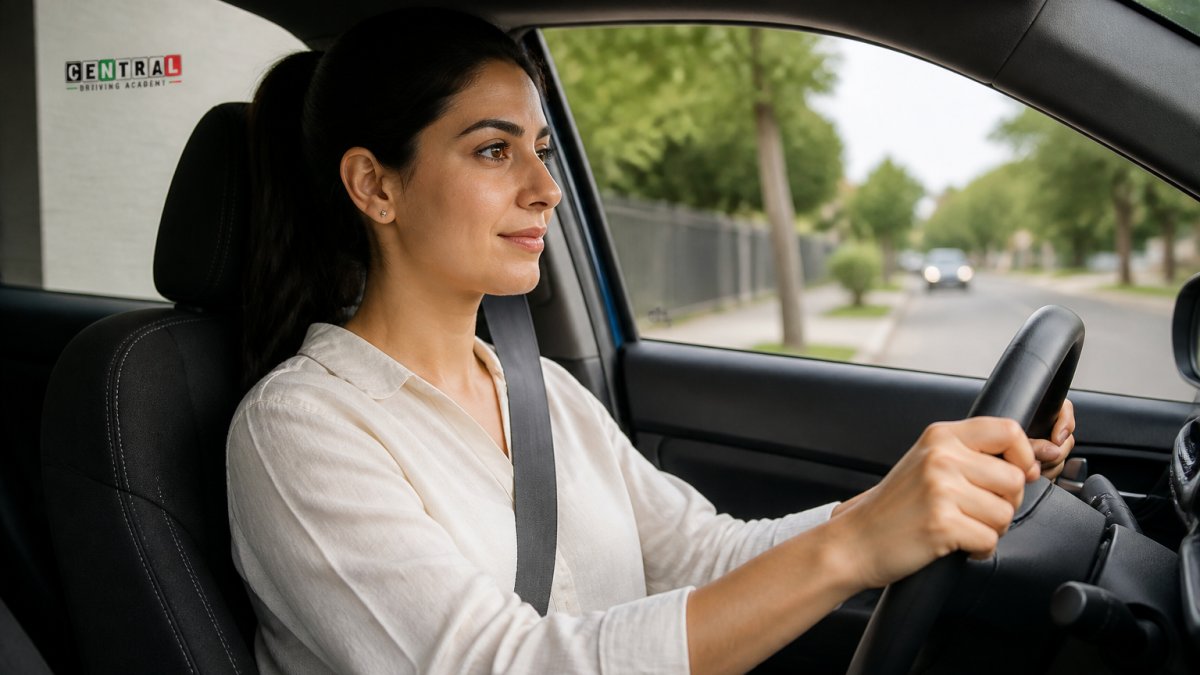
Know what the examiner is actually scoring.
Examiners evaluate four main areas:
Vehicle control: Smooth steering, braking, and acceleration. Jerky movements or repeated over-corrections show poor control.
Hazard awareness: Check mirrors and blind spots before turning, changing lanes, or braking.
Rule compliance: Follow speed limits, stop at lines, signal at the right time, obey traffic signals. Violations are immediate failures or major deductions.
Decision-making: Choose safe speeds for conditions, position correctly before turns, respond appropriately to unexpected situations. Think before you act.
Understand what causes immediate failure versus what’s recoverable.
Immediate failures (test ends):
- Unsafe behavior that puts anyone at risk (running a red light, failing to yield, driving into oncoming traffic)
- Hitting another vehicle or object
- Failing to follow the examiner’s instructions
- Driving without proper control (e.g., stalling repeatedly, unable to manage the vehicle)
Major deductions (significant impact on score):
- Failing to check mirrors or blind spots before turning or changing lanes
- Stopping past the line at a stop sign or traffic light
- Signalling too late or not at all
- Drifting out of your lane
- Speeding or driving too slowly for conditions
- Poor parking technique (multiple attempts, hitting the curb)
Minor deductions (recoverable):
- A small hesitation at an intersection
- Slightly imperfect lane positioning that you correct
- A minor mirror check you missed but the road was clear
- Slight jerking when you start from a stop
Knowing the difference matters: a minor mistake doesn’t fail you. Unsafe behavior does.
Prepare thoroughly to shrink anxiety.
Anxiety shrinks when you’ve practiced. Preparation builds confidence. Confidence reduces anxiety.
During your mock test, ask your instructor to score you using the same rubric the examiner will use. Ask which areas are solid and which need work. This feedback is gold, it tells you exactly what to focus on in your final practice sessions. When you know you’ve fixed your weak spots, anxiety loses its grip.
Use specific techniques on test day.
Breathe before you start. Take three deep breaths before the examiner gets in the car. This calms your nervous system and signals to your body that you’re in control.
Focus on the task, not the judgment. The examiner isn’t looking for perfection. They’re looking for safety. Drive the route you’ve practiced. Follow the rules. Make safe decisions. That’s all they need.
Accept that small mistakes happen. Everyone makes them. A small mistake doesn’t fail you. If you miss a mirror check but the road was clear, keep driving. If you drift slightly out of your lane but correct it immediately, keep driving. Recover from mistakes and move forward. The examiner expects composure, not perfection.
Talk to your instructor about your specific fears. If parallel parking terrifies you, practice it 20 times before test day. If heavy traffic makes you nervous, practice during rush hour. If rain worries you, practice in wet conditions. Facing your fears in practice removes their power on test day.
Remember that you’ve done this before. You’ve driven in traffic. You’ve parked in tight spaces. You’ve handled unexpected situations. The test is just a formal version of what you already do. Trust your experience.
The night before your test, review your checklist but don’t practice driving. Your brain needs rest, not more input. You’re ready. Confidence comes from knowing you’ve prepared and understanding what the examiner is looking for, not from last-minute cramming.
Final Preparations and What to Bring
The week before your test, shift from learning to confirming.
Do one or two final practice drives focusing on smooth, safe execution. Don’t try new techniques. Stick with what you’ve practiced. Consistency matters more than perfection.
Get good sleep the three nights before your test. Fatigue makes everything harder. You’ll be slower to react and more likely to make mistakes. Sleep is part of your road test preparation for adults.
Eat a proper meal before your test. Low blood sugar makes you shaky and unfocused. Eat something familiar that doesn’t upset your stomach. Avoid heavy foods that make you drowsy.
Dress comfortably. Wear clothes that don’t restrict movement. Avoid anything that makes you feel self-conscious. You want to feel normal and confident, not uncomfortable.
Bring all required documents:
- Your learner’s license
- Proof of insurance
- Vehicle registration
- A valid photo ID
Arrive 15 minutes early. This gives you time to settle your nerves, adjust mirrors and seat, and take a few deep breaths. Rushing increases anxiety.
Drive to the test center a few days before if possible. Know where the parking is. Know where the office is. Remove any uncertainty about logistics.
The road test preparation for adults isn’t about becoming a perfect driver. It’s about proving you can drive safely in real traffic. You’ve learned the rules. You’ve practiced the skills. You know what the examiner is looking for. Trust your preparation, stay calm, and drive the way you’ve practiced.
At Central Driving Academy, we’ve guided hundreds of adults through this process. Our certified instructors under the Motor Vehicle Act provide mock tests, structured practice, and the confidence boost that turns nervous learners into safe drivers. We offer free in-person assessments and provide the road test vehicle itself, so there are no surprises on exam day. If you’re ready to prepare seriously, book your assessment with Central Driving Academy and let us help you prepare for your road test.
Frequently Asked Questions
What should I practice most before my road test preparation for adults?
Focus on the maneuvers that appear most often on road tests: parallel parking, lane changes, smooth stopping, and turning at intersections. Practice in varied traffic conditions and times of day. Adults often benefit from deliberate practice on weak areas identified during mock tests. Spend extra time on observation skills, mirror checks, and blind spot awareness, examiners prioritize hazard awareness and defensive driving.
How can I use an ICBC road test checklist to prepare effectively?
Break the ICBC road test checklist into sections: vehicle safety checks, traffic laws, parking techniques, and observation skills. Practice each item systematically during lessons and mock tests. Record which checklist items you struggle with and dedicate extra practice time to those areas. Review the checklist the night before and the morning of your test to reinforce what the examiner will assess.
What are the most common road test mistakes adults make?
Adults often fail due to poor observation (not checking mirrors and blind spots), hesitating at intersections, speeding or driving too slowly, and inconsistent lane positioning. Nervousness can cause jerky steering or abrupt braking. Using a structured practice plan with feedback from a certified instructor helps catch and correct these habits before test day.
How do driving test anxiety tips help me pass on my first attempt?
Anxiety management techniques, deep breathing, visualization, and arriving early, reduce test-day stress and help you focus on core skills. Knowing exactly what to expect from the examiner and the route reduces uncertainty. Certified instructors who specialize in adult driving lessons can teach anxiety-reduction strategies tailored to your needs, increasing your chances of passing.