
Table of Contents
- Why Nervous Beginners Need Specialized Driving Lessons
- How to Overcome Driving Anxiety Before Your First Lesson
- What to Expect: Your First Driving Lesson and Beyond
- ICBC Road Test Preparation for Beginners
- Cost of Driving Lessons in British Columbia: What You’ll Pay
- Choosing the Right Instructor: Key Questions to Ask
- Defensive Driving Techniques Every Beginner Should Master
- Conclusion
- Frequently Asked Questions
Last Updated: October 7, 2026
Why Nervous Beginners Need Specialized Driving Lessons
Driving lessons nervous beginners receive are fundamentally different from standard instruction. When anxiety is part of the equation, a patient, structured approach becomes essential. Many nervous drivers have experienced setbacks, failed tests, close calls, or simply watching others drive confidently while they feel paralyzed behind the wheel. That experience shapes how they learn and what they need from an instructor.
At Central Driving Academy, nervous beginners benefit most from instructors who understand the psychology of driving anxiety, not just the mechanics of vehicle control. The difference shows up immediately: a nervous driver paired with an impatient instructor will tense up, miss details, and reinforce their fear. The same driver with a calm, encouraging instructor begins to relax, absorb information, and build genuine confidence.
The real issue isn’t that nervous drivers lack ability. It’s that they need a learning environment designed specifically for their mindset. This means smaller, progressive challenges. It means clear explanations before attempting maneuvers. It means an instructor who recognizes that a moment of panic is temporary, not a sign of failure. Specialized driving lessons for nervous beginners create that environment intentionally.
How to Overcome Driving Anxiety Before Your First Lesson
Driving anxiety often peaks before you even get behind the wheel. Understanding what triggers your fear, and having concrete strategies to manage it, makes your first lesson far more productive.
Start by identifying your specific worry. Is it fear of hitting someone? Anxiety about highway speeds? Panic about parallel parking? Getting specific matters because your anxiety response depends on the trigger.
Once you’ve named the fear, separate it from reality. Many nervous drivers catastrophize: they imagine worst-case scenarios and treat them as likely outcomes. The truth is that millions of people drive safely every day. Your instructor has taught many nervous beginners who are now confident drivers.
Try this before your first lesson: spend 10 minutes sitting in a parked car. Get comfortable with the seat position, the mirrors, the steering wheel. Practice adjusting controls without the engine running. Familiarity reduces anxiety.
On the day of your lesson, arrive early. Rushing amplifies anxiety. Meeting your instructor in a relaxed state sets the tone. Be honest about your fears. A good instructor, like those at Central Driving Academy, will adjust the lesson plan based on what you tell them.
Before your first lesson, practice deep breathing: inhale for 4 counts, hold for 4, exhale for 6. The longer exhale activates your parasympathetic nervous system, which calms anxiety. Use this technique during your lesson whenever you feel tension building.
What to Expect: Your First Driving Lesson and Beyond
The assessment phase
Your first lesson isn’t about perfect execution. It’s about establishing where you are right now. A professional instructor will spend the initial minutes understanding your experience level, your specific fears, and your goals. They’ll ask questions: Have you driven before? What situations make you most anxious? When do you want to pass your road test?
This assessment determines everything that follows. If you’ve never touched a steering wheel, the lesson focuses on basic vehicle familiarization. If you’ve driven but only in quiet neighborhoods, the plan emphasizes building comfort in busier environments.
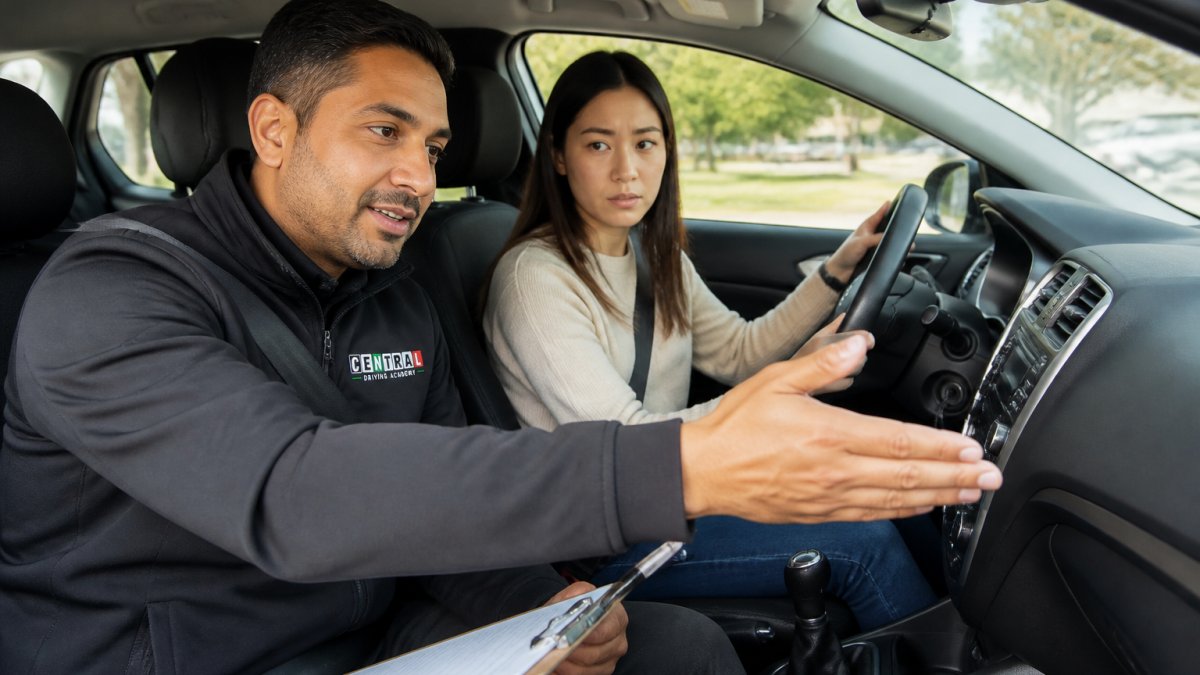
Expect your instructor to walk you through every control methodically. Where is the ignition? How do the mirrors adjust? What do the pedals do? This isn’t condescending, it’s thorough. Nervous drivers often skip these basics because they feel obvious, then struggle later when they’re not sure where something is.
Building skills progressively
After the assessment, your lessons follow a structured progression. You won’t jump from parking lot basics to highway driving in one session. The sequence typically moves like this: basic controls in an empty lot, slow-speed maneuvers in quiet residential streets, busier local roads, then eventually highway driving and complex intersections.
Each step builds on the previous one. Your confidence grows because you’re not overwhelmed. You master one skill, smooth acceleration, for example, before adding the next challenge. This progressive approach is what separates specialized instruction from rushing through material.
Your instructor tracks your progress. They notice when you’re ready to advance and when you need more practice on a specific skill. Defensive driving techniques are woven throughout, not saved for the end. You learn hazard perception early, spotting potential dangers before they become emergencies, because it’s foundational to safe driving.
The best driving lessons nervous beginners need follow a clear progression: assessment → basic controls → quiet streets → busier roads → highway driving. Rushing this sequence is the most common reason nervous drivers don’t build lasting confidence.
ICBC Road Test Preparation for Beginners
The ICBC road test is the moment that matters most. You’ll drive with an examiner who evaluates your vehicle control, hazard awareness, and adherence to traffic laws.
Preparation starts weeks before test day. Your instructor should specifically teach to ICBC standards, not just general driving. This means understanding exactly what the examiner is looking for: smooth gear changes, proper mirror checks, correct signaling, safe speeds, and appropriate responses to hazards.
A common mistake is practicing only the skills you’re good at. If parallel parking terrifies you, that’s exactly what you need to practice repeatedly until it feels automatic. The ICBC test includes parking maneuvers, and your anxiety will peak during them.
Central Driving Academy provides the road test vehicle itself, which removes a major source of stress. You won’t be learning a new car on test day. You’ll be familiar with how it handles, where the controls are, and how it responds.
Test day itself requires a different mindset. You’ll be nervous, that’s normal. The examiner expects nervous drivers. What they’re assessing is whether you can manage that nervousness and still drive safely. Take your time. If you need a moment before pulling into traffic, take it.
Cost of Driving Lessons in British Columbia: What You’ll Pay
Driving lesson pricing in British Columbia varies based on instructor credentials, location, and lesson structure. Rather than quote specific rates that may change, we recommend contacting Central Driving Academy directly for current pricing and available lesson packages. Pricing depends on factors like lesson duration, frequency, and whether you need specialized services like pickup and drop-off.
When evaluating cost, consider what’s included. Some instructors offer only the lesson itself. Central Driving Academy includes a free assessment, pickup and drop-off service, and provision of a road test vehicle, services that add real value beyond the hourly rate. A slightly higher per-lesson cost often represents better overall value when additional services are factored in.
Many nervous drivers benefit from package deals that commit them to multiple lessons. Consistency matters more than sporadic practice. A nervous driver who takes one lesson per week for eight weeks will progress faster than one who takes lessons sporadically over several months. Ask about package pricing when you contact an instructor.
Choosing an instructor based on price alone often backfires for nervous drivers. The cheapest option may lack patience or experience with anxiety-related learning challenges. Invest in an instructor who specializes in nervous beginners, the confidence you build is worth more than the money you save.
Choosing the Right Instructor: Key Questions to Ask
Finding the right instructor is as important as the lessons themselves. A mismatch can reinforce your anxiety; the right fit accelerates your progress. Here are the questions that matter most.
Are you certified under the Motor Vehicle Act? This is non-negotiable. Certified instructors have met provincial standards and carry insurance. They understand ICBC requirements because they’re trained to teach to them.
How long have you worked with nervous drivers? Experience matters. An instructor with 15 years of experience teaching overconfident teenagers is not the same as one with 5 years teaching anxious adults. Ask for specifics:
What’s your teaching approach? Listen to how they describe it. Do they focus on building confidence alongside skills? Do they explain why things matter, or just drill procedures? A good instructor will tell you they start with assessment, progress gradually, and tailor lessons to your anxiety triggers.
Do you provide the road test vehicle? This is a practical advantage. You won’t be learning a new car on test day. This alone reduces test-day stress significantly.
Can you accommodate my schedule? Nervous drivers often have busy lives, school, work, family commitments. Flexible scheduling matters. Central Driving Academy offers six-day availability, which removes the excuse of “I can’t find a time that works.”
Do you offer bilingual instruction? If English isn’t your first language, this is essential. Learning complex driving terminology in a non-native language while managing anxiety is doubly difficult. Central Driving Academy offers bilingual instruction in English and Farsi specifically to address this challenge.
Ask for references or reviews. Real feedback from other nervous drivers who’ve worked with this instructor is invaluable. Google reviews, testimonials, and word-of-mouth recommendations all matter.
Defensive Driving Techniques Every Beginner Should Master
Defensive driving isn’t just about following rules. It’s about anticipating danger and positioning yourself to avoid it. Nervous drivers often focus so hard on their own vehicle control that they miss what’s happening around them. Defensive driving flips that priority: awareness first, control second.
The foundation is scanning. Your eyes should move constantly, mirrors, blind spots, road ahead, pedestrians. Most nervous drivers stare at the road directly in front of them, which means they miss hazards until they’re immediate threats.
Positioning is the second pillar. Where you place your vehicle matters as much as how you control it. If you’re in the right lane of a busy road, you have an escape route if something goes wrong ahead.
Speed management is the third technique. Nervous drivers often drive too slowly, which creates its own dangers. The goal is driving at a speed that matches conditions and gives you time to react. On a wet road, that’s slower. On a clear highway, it’s faster.
Finally, learn to read other drivers. A car drifting between lanes is driven by someone distracted or impaired. A car with a brake light out is piloted by someone who may not be checking their mirrors.
Practice the “two-second rule” on every drive: pick a stationary object, note when the car ahead passes it, count “one Mississippi, two Mississippi.” If you reach it before you finish counting, you’re following too closely. This simple technique gives you the time you need to react to sudden stops.
Conclusion
Nervous drivers often assume their anxiety means they’re not cut out for driving. That’s simply not true. Anxiety is manageable. Confidence builds through structured practice with a patient instructor who understands both the technical and psychological sides of driver education. The right instruction, from someone certified under the Motor Vehicle Act who has experience teaching anxious beginners, changes everything. Central Driving Academy specializes in this exact situation: building confident, safe drivers from nervous beginners through personalized instruction, flexible scheduling, bilingual support, and provision of a road test vehicle. When you’re ready to transform anxiety into competence, get started with Central Driving Academy and take the first step toward the independence and safety that confident driving brings.
Frequently Asked Questions
What should I look for in a driving instructor if I have anxiety?
Find an instructor with experience working specifically with nervous drivers. Ask about their approach to building confidence, their certifications under the Motor Vehicle Act, and whether they offer a free assessment. Patient instructors who explain techniques clearly and allow you to progress at your own pace reduce anxiety significantly. Bilingual options can also help if English terminology feels overwhelming.
How much do driving lessons cost in BC, and what affects the price?
Driving lesson pricing depends on lesson duration, package size, instructor experience, and whether services like pick-up and drop-off are included. For current pricing and package options, contact your chosen driving academy directly for a quote. Many schools offer flexible packages to fit different budgets and schedules.
How many driving lessons does a nervous beginner usually need before the ICBC road test?
This varies based on your starting point and learning pace. Most nervous beginners benefit from professional instruction combined with supervised practice. Your instructor will assess your progress during lessons and recommend how many additional sessions you need before attempting the ICBC road test.
What is the role of an ICBC-certified instructor in building confidence?
ICBC-certified instructors are trained in standardized teaching methods and understand the exact requirements of the road test, which reduces uncertainty. They know how to structure lessons to build skills progressively and provide feedback based on professional standards. Certification also means they’re accountable to regulatory standards, giving you assurance of quality instruction.