
Table of Contents
- What to Expect From Private Driving Lessons With Pickup
- How to Choose a Certified Driving Instructor
- Understanding Private Driving Lesson Packages
- Preparing for Your ICBC Road Test With Private Instruction
- Road Test Vehicle Rental and Test Day Logistics
- How to Book and Schedule Your Lessons
- Managing Driving Anxiety During Lessons
- Frequently Asked Questions
Last Updated: September 18, 2026
What to Expect From Private Driving Lessons With Pickup
Private driving lessons with pickup provide one-on-one instruction at your location, eliminating transportation barriers and letting you focus on building skills and confidence.
Pickup convenience removes scheduling friction, allowing nervous learners to start immediately and practice on their own timeline.
Sessions vary by skill level: beginners start with basic controls in quiet streets; intermediate drivers preparing for their ICBC road test focus on highway merging, parking, and busy intersections. Instructors adjust pacing and provide real-time feedback based on your progress.
Many nervous drivers find that starting in their own neighborhood, where they feel grounded, makes the first lesson significantly less intimidating than heading straight to unfamiliar roads. Request this if anxiety is a concern.
How to Choose a Certified Driving Instructor
The right instructor accelerates progress and reduces anxiety. The decision hinges on credentials, teaching style, and fit with your needs.
Verify Motor Vehicle Act Certification
Any instructor must be certified under British Columbia’s Motor Vehicle Act, the legal standard ensuring training requirements and background checks are met. Reputable schools provide verifiable documentation.
Ask directly: “Are your instructors certified under the Motor Vehicle Act?” A straightforward yes with verifiable credentials is your baseline requirement.
Beyond base certification, look for additional training in defensive driving or experience with anxious learners, signals of professional commitment.
Assess Teaching Style and Communication
Certification proves competence; teaching style determines whether you’ll learn. Your preference matters because you’ll spend hours with this person.
Request a free in-person assessment before committing. Pay attention to whether the instructor listens to your concerns, explains clearly, and doesn’t rush you.
Ask: How do you handle mistakes? How do you work with nervous students? Can you adjust lessons based on progress? Their answers reveal whether they’re adaptive.
The best instructor for you is one who listens to your specific concerns, explains concepts clearly, and adjusts pacing based on your comfort level, not the one with the cheapest rate or shortest wait time.
Understanding Private Driving Lesson Packages
Understanding package structure and inclusions prevents surprises and helps you choose the right option for your timeline and budget.
Single Lessons vs. Multi-Lesson Packages
Single lessons offer maximum flexibility and work well for unpredictable schedules or testing an instructor before committing.
Multi-lesson packages (5-20 lessons) cost less per hour and create momentum for test preparation. Most learners benefit from packages because they prevent long gaps between sessions.
Choose single lessons for unpredictable schedules; choose packages for consistent weekly practice toward a test date.
What’s Included in Your Lessons
Standard inclusions are instructor time, in-car instruction, and feedback. Offerings vary: some schools provide vehicles; others require your own car. Some include mock tests; others charge separately.
Central Driving Academy includes pickup and drop-off, free assessments, and access to a road test vehicle for your ICBC exam, removing logistical friction.
Ask: What vehicle? Rescheduling policy? Are mock tests included? Is feedback written or verbal? Clarity upfront prevents frustration.
Preparing for Your ICBC Road Test With Private Instruction
Private instruction designed around ICBC test requirements gives you a measurable advantage because your instructor knows exactly what examiners assess.
Mock Road Tests and Feedback
A mock road test simulates the actual ICBC exam with the same routes, criteria, and pressure. Your instructor assesses performance and identifies areas needing improvement.
Mock tests reveal gaps before your official exam, allowing your instructor to focus remaining lessons on your specific weaknesses.
Central Driving Academy structures lessons around ICBC requirements and provides access to the road test vehicle, eliminating unfamiliar controls on exam day.
Building Confidence Before Your Test
Confidence results from repeated successful practice in progressively challenging conditions: early lessons in low-stress environments, mid-stage on busier roads, final lessons simulating test conditions.
Structured progression allows your brain to internalize skills before high-pressure situations. Throwing nervous drivers into heavy traffic too early increases anxiety; gradual progression builds genuine competence.
Cramming lessons into the week before your test rarely works. Last-minute practice doesn’t create lasting skill development and often increases anxiety. Plan to complete your lessons at least 2-3 weeks before your exam date to allow time for skills to consolidate.
Road Test Vehicle Rental and Test Day Logistics
Securing a compliant vehicle for your ICBC exam is stressful. Many learners don’t own a car or their family vehicle doesn’t meet requirements. Unfamiliar vehicle controls on test day add hidden anxiety.
Understanding Dual-Brake Safety Systems and Why They Matter
A dual-brake system allows an instructor to operate brakes from the passenger seat, a legal requirement for professional instruction. Understanding it reduces anxiety because you know the instructor has active control.
The instructor’s brake pedal is mechanically or electronically linked to the main braking system. If you hesitate or approach too quickly, the instructor can gently apply their brakes. This lets you practice challenging situations with a safety net while building real competence.
Nervous drivers report that understanding the dual-brake system transforms their mindset. Instead of catastrophizing, they focus on learning because they trust the instructor has control. This psychological shift measurably accelerates progress.
Ask your instructor to explain and demonstrate the dual-brake system during your first session. This demystifies the feature and reinforces that the vehicle is designed for learning.
Vehicle Inspection Standards and What “Safety-Inspected” Actually Means
ICBC requires vehicles used for road tests to meet specific safety standards, ensuring the examiner can safely assess your driving (Prepare for your road test appointment).
The ICBC vehicle inspection checklist includes: dual-brake system, all three mirrors clean and adjusted, all lights functioning, tires with minimum 1.6 mm tread, working wipers and washers, functional seatbelts, audible horn, and clean windows.
A “safety-inspected” vehicle has passed the checklist and is documented as compliant. Practicing in a school vehicle eliminates the risk of discovering mid-exam that wipers don’t work or mirrors are misaligned.
Central Driving Academy provides road test vehicles. You practice in the exact car you’ll use for your ICBC exam, eliminating unfamiliar controls or mechanical surprises.
Practicing in Your Test Vehicle vs. Your Own Car
Practicing in your family car versus your test vehicle creates meaningful differences in brake feel, turning radius, and mirror positioning that become distractions on test day.
Early lessons can use your own car for foundational confidence, but transition to the test vehicle 4-6 lessons before your exam. This internalizes brake feel, mirror sight lines, and handling so the car feels familiar on test day.
Arrive 15 minutes early with your learner’s license, proof of insurance, and school documentation. The examiner will inspect lights, wipers, and mirrors. Familiarity with the vehicle anchors confidence when pressure is highest.
How to Book and Schedule Your Lessons
Understanding the booking process, required documents, deposits, and scheduling, prevents surprises and helps you move forward confidently.
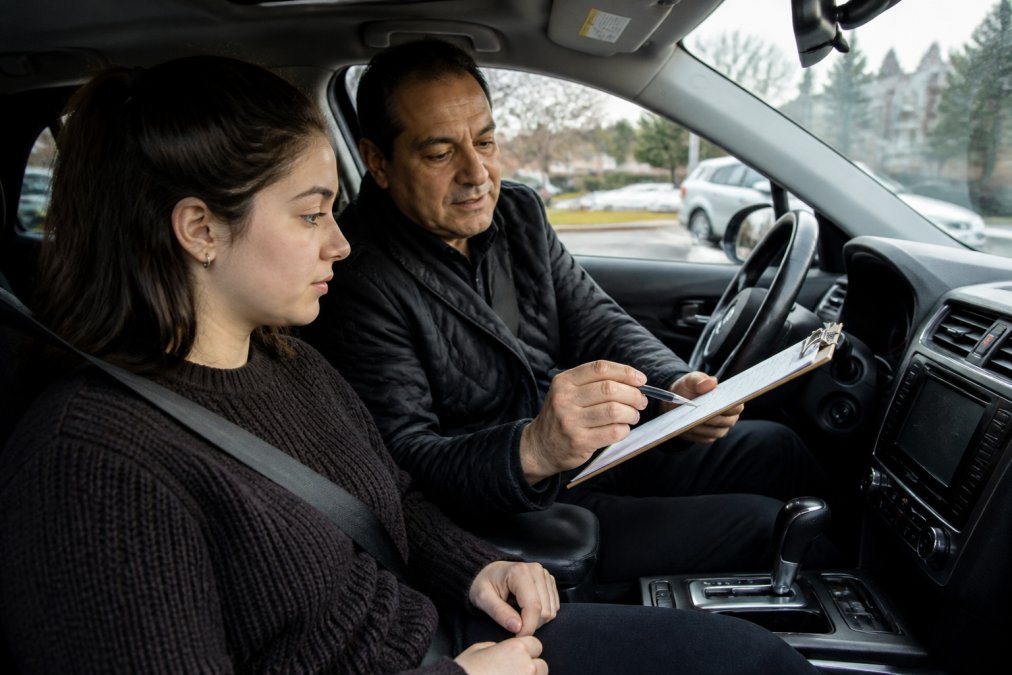
Step 1: Initial Contact and Consultation
Contact the driving school by phone, email, or online form to discuss your driving experience, goals, and availability.
Be specific: mention if you’re nervous, your test date, and preferred lesson times.
Step 2: Documentation and Eligibility Verification
Standard documentation includes: valid learner’s license, government-issued ID, proof of residency (utility bill, lease, or bank statement), proof of insurance (if using your own vehicle), and emergency contact information.
Step 3: Package Selection and Deposit
Choose a lesson package (5-20 lessons). Students preparing for ICBC tests typically need 10-15 lessons; nervous drivers building confidence might start with 5-8.
Confirm the cancellation policy before paying.
Step 4: Scheduling Your Pickup Times
Provide your address, preferred lesson times, and special requests. The school confirms availability and schedules the instructor to arrive at your location.
Step 5: Pre-Lesson Preparation
Bring your learner’s license and proof of insurance. Wear comfortable clothing and shoes. Eat a light meal beforehand.
Managing Your Lesson Schedule and Progress Tracking
Consistency matters: weekly lessons develop skills progressively. Two-week breaks mean relearning basics instead of advancing.
Request a written lesson plan or progress checklist at your consultation. This document outlines what skills you’ll practice in each lesson phase (foundational, intermediate, advanced, test preparation). It keeps both you and your instructor aligned and gives you a clear sense of progress.
Managing Driving Anxiety During Lessons
Nervousness about driving is normal. Private instruction offers a controlled environment where anxiety can be addressed directly.
Frequently Asked Questions
What should I expect during my first private driving lesson with pickup?
Your first lesson typically begins with the instructor arriving at your location for pickup. Expect an introduction to the vehicle, a discussion of your current skill level, and a free in-person assessment to identify your learning needs. The instructor will explain what to expect, answer your questions, and then conduct behind-the-wheel training in a safe environment. Most first lessons focus on building comfort with the vehicle and basic controls before moving to road conditions.
How do I verify if a driving instructor is certified under the Motor Vehicle Act?
Ask for proof of certification directly from your instructor or the driving school. Certified instructors under the Motor Vehicle Act have credentials that demonstrate they meet provincial standards for driver education. You can also check with the driving school’s accreditation status and ask about their instructor training. Legitimate schools will provide this information openly without hesitation.
How many hours of private driving instruction are recommended before taking your ICBC road test?
The number of hours varies based on your starting skill level and learning pace. Nervous or beginner drivers may need 10-20 hours, while more experienced learners might need 5-10 hours. Your instructor will assess your readiness during mock road tests and provide a personalized recommendation. Most students benefit from a combination of private lessons focused on weak areas, combined with independent practice between lessons.
Do I need to provide my own vehicle for private driving lessons and the road test?
No. Many certified driving schools offer road test vehicle rental as part of their service, ensuring the vehicle meets all ICBC requirements. This eliminates the stress of finding a compliant vehicle and lets you practice in the exact car you’ll use for your test. Confirm vehicle provision when booking your lessons, as this is a key convenience of using a professional driving school.
Private driving lessons with pickup remove logistical barriers and provide personalized instruction tailored to your pace and goals. Central Driving Academy combines certified instructors, flexible scheduling, and road test vehicle access to prepare you thoroughly for your ICBC exam. Get started with Central Driving Academy and build the driving confidence and skills you need to pass your test and drive safely.