
Last Updated: November 19, 2026
Quick Summary
Winter driving in Canada starts with preparation: install four matching winter tires, check tire pressure monthly, and pack a scraper, brush, and emergency kit. On snow and ice, slow down, double your following distance to at least four seconds, and steer smoothly. If you skid, ease off the gas and steer where you want the car to go.
- Fit four matching winter tires, never just two, because mismatched grip upsets steering balance on ice.
- Double your following distance to at least four seconds, and add more at highway speed.
- Ease off the gas and steer toward your intended path to stop a skid; avoid hard braking.
- Keep a winter emergency kit in the vehicle all season and restock it each month.
- Clear snow, slush, and road salt from ADAS cameras and sensors before you drive.
Table of Contents
- Winter Driving Preparation Checklist
- How to Drive on Snow and Ice
- How to Stop a Car from Skidding on Ice
- Winter Car Emergency Kit: What to Pack
- Driving in Extreme Cold and Whiteout Conditions
- How ADAS and EVs Change Winter Driving
- Book a Winter Driving Lesson with Central Driving Academy
- Frequently Asked Questions
Winter Driving Preparation Checklist
Winter driving in Canada demands preparation long before the first snowfall. The car you drive in January is only as safe as the work you did in October. This winter driving preparation checklist covers the essentials.
Start with winter tires. Winter tires use softer rubber and deeper tread to hold the road in cold conditions. Check tire pressure monthly, because cold air lowers it fast. Top up windshield wiper fluid with a winter-grade mix, replace worn wiper blades, and test your defroster and heater.
- Install four matching winter tires
- Check tire pressure and tread depth monthly
- Swap in winter wiper fluid and new blades
- Test the defroster, heater, and battery
- Pack a scraper, brush, and emergency kit
Fitting winter tires on only two wheels upsets the balance between grip and steering, especially on ice. Fit all four.
Here is the preparation checklist the article recommends completing before the first snowfall.
| Task | Detail |
|---|---|
| Install winter tires | Fit four matching winter tires, never just two |
| Check tire pressure | Check monthly; cold air lowers pressure fast |
| Swap wiper fluid and blades | Use winter-grade fluid and replace worn blades |
| Test defroster, heater, and battery | Confirm all work before winter arrives |
| Pack a scraper, brush, and emergency kit | Keep essentials in the vehicle all season |
How to Drive on Snow and Ice
Learning how to drive on snow and ice comes down to three habits: slow down, leave space, and steer smoothly. Snow and ice cut traction, so every input, from the throttle to the brake to the wheel, needs to be gentler than in summer. Understanding why the surface behaves the way it does helps drivers adapt, because the same habit that works on packed snow can fail on wet-looking pavement.
Here is how we teach it:
- Accelerate slowly to avoid wheel spin, and ease off the throttle the moment you feel the tires break loose.
- Double your following distance to at least four seconds, and add more at highway speed; a four-second gap at 100 km/h is roughly 110 metres, which is longer than most new drivers estimate.
- Brake early and gently, never in a panic, and finish braking before you begin to turn.
- Steer with small, smooth movements and keep both hands on the wheel.
- Look where you want to go, not at the hazard.
Why the surface changes under you. Fresh snow offers some grip; packed snow offers less; ice offers almost none. The most dangerous state is the freeze-thaw cycle common on Canadian roads, where daytime melting refreezes overnight into a thin, transparent glaze. That glaze is what drivers call black ice, and it forms first on bridges and overpasses because cold air moves under the deck, and in shaded stretches and underpasses that never see sun. Road salt and brine lower the freezing point and turn snow into a wet slush that refreezes when the temperature drops, so a road that looked merely wet at 4 p.m. can be slick by 7 p.m.
City versus highway. In stop-and-go city driving, the risk is low-speed loss of grip at intersections and on hills, where packed snow polishes into ice under repeated braking. On rural highways, the risk shifts to speed: a small steering input at 100 km/h travels much further than the same input at 40 km/h, and snow drifts across open stretches can pull a car sideways without warning. Slow down more than you think you need to before a curve, not in it.
Watch out: all-wheel drive helps you accelerate but does nothing to shorten braking distance, so do not let it tempt you into carrying extra speed into a corner.
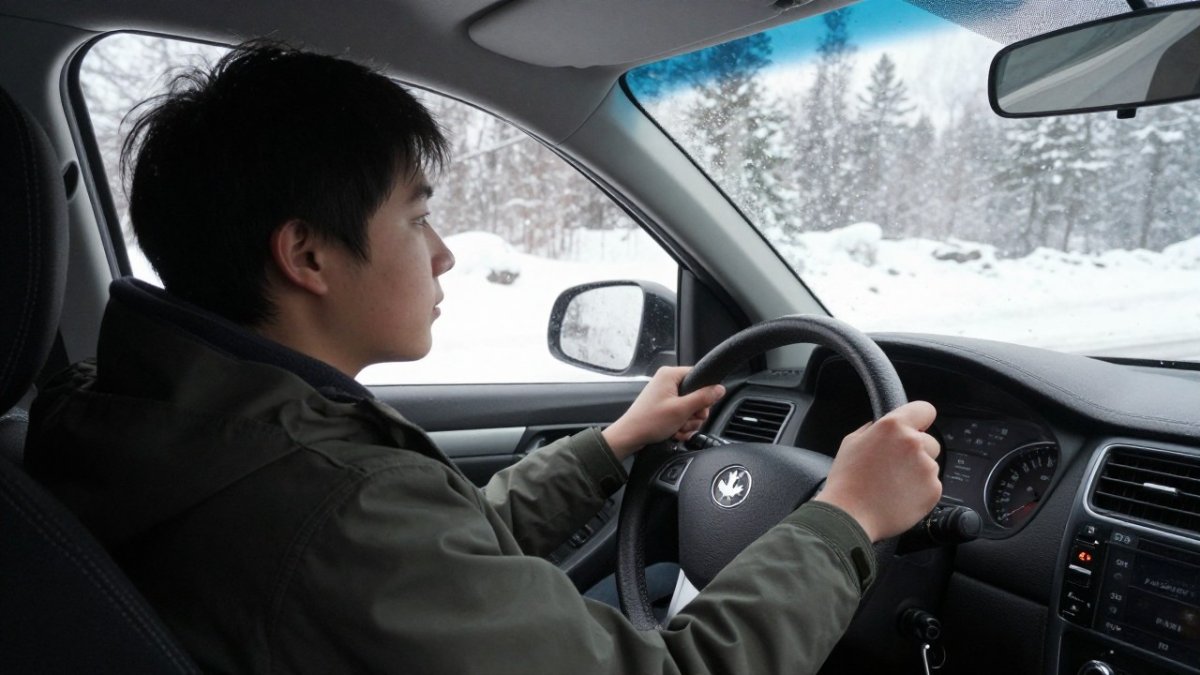
If you feel nervous on slick roads, that is normal. A structured approach helps. Our guide on driving lessons for nervous beginners explains how to build calm control step by step, and our article on how to overcome driving anxiety as a beginner covers breathing and focus techniques for slippery conditions.
How to Stop a Car from Skidding on Ice
To stop a car from skidding on ice, ease off the gas and steer where you want the front of the car to go. Do not slam the brakes. A skid happens when tires lose grip, and sudden inputs make it worse.
Here is the sequence:
- Take your foot off the accelerator.
- Look and steer toward your intended path.
- Avoid hard braking; let the car slow naturally.
- Once grip returns, brake gently.
Black ice is a thin, transparent layer of ice that looks like wet pavement. It forms most often on bridges, overpasses, and shaded stretches. Traction control and the anti-lock braking system help, but they cannot create grip that is not there. Treat them as backup, not permission to drive faster.
Winter Car Emergency Kit: What to Pack
A winter car emergency kit is a set of supplies you keep in the vehicle all season, so a breakdown or storm never leaves you stranded and unprepared. Pack it before winter starts and check it monthly. The goal is not a perfect list; it is a kit that still works at -25°C after sitting in the trunk for six weeks.
Build it in three layers so you can grab what you need without unpacking everything:
Layer 1, Traction and extraction (the trunk box)
- A small folding shovel, ideally a compact snow shovel rather than a garden spade
- Sand, kitty litter, or a commercial traction mat; a bag of sand doubles as ballast in a light rear-wheel-drive car
- Booster cables rated for cold cranking, or a lithium jump starter kept inside the cabin, not the trunk
- A tow strap and a reflective triangle or flares
- Work gloves and a folding knife
Layer 2, Warmth and survival (the cabin bag)
- A wool or synthetic blanket and a spare hat, gloves, and boots per occupant
- Hand warmers and a metal cup or small pot for melting snow
- High-calorie snacks that survive freezing (nuts, granola bars) and water in a flexible bottle, because rigid bottles crack when water freezes
- A first-aid kit and any personal medication
- A phone charger and a charged power bank
Layer 3, Visibility and signaling
- A flashlight with lithium batteries (alkaline cells lose capacity fast in deep cold)
- A scraper and brush kept in the cabin, not the trunk, so you can clear the car before you drive
- A spare pair of winter wiper blades
A common pattern is a kit packed in summer and never checked, which leaves you with a dead flashlight, frozen water, and a jump starter that lost its charge. Restock it each month and replace anything that has been used.
Watch out: never run the engine in a snowbound car unless the exhaust pipe is clear of snow, and crack a window for fresh air; carbon monoxide has no smell and builds up quietly.
If you drive an electric vehicle, add a 12-volt jump starter and a charging cable rated for the cold, and keep the cabin bag accessible from the driver’s seat rather than buried under cargo.
Driving in Extreme Cold and Whiteout Conditions
Extreme cold and whiteout conditions are where experience matters most. In deep cold, an engine block heater helps a cold start and keeps the battery happier. Check the wind chill before you leave, and skip non-essential trips when a whiteout is forecast.
In a whiteout, pull off the road safely, turn on your hazards, and stay in the car. Do not walk into traffic. Keep the engine running only if the exhaust pipe is clear of snow, and crack a window for air. For roadside help, keep a roadside assistance number saved in your phone.
How ADAS and EVs Change Winter Driving
Advanced driver assistance systems and electric vehicles change how winter driving works, but neither replaces a skilled driver. ADAS features like lane-keeping and automatic emergency braking rely on cameras and sensors. Snow, slush, and road salt can block those sensors, so clear them before you drive.
EVs bring their own nuances. Cold reduces battery range, and regenerative braking can feel different on ice. Precondition the battery while plugged in, and use gentler settings in snow.
If you want to understand these systems properly, our guide on how to choose an advanced defensive driving course explains what to look for. The lesson is simple: technology assists, the driver decides.
Book a Winter Driving Lesson with Central Driving Academy
Reading about winter driving only goes so far. Real confidence comes from practice with a patient, certified instructor beside you. Central Driving Academy teaches new drivers across Coquitlam, Port Coquitlam, and Port Moody, with bilingual instruction in English and Farsi.
Our instructors are certified under the Motor Vehicle Act, and we offer a free in-person assessment, pick-up and drop-off, and a road test vehicle for your ICBC test. Nervous about your first lesson? Our guide on how to find patient driving instructors shows what to look for before you book. When you are ready, here is how to book a driving lesson online, step by step.
Winter rewards the prepared driver.
Winter driving does not have to feel risky. With the right preparation and a patient instructor, you can handle snow, ice, and cold with confidence. Central Driving Academy offers certified instruction under the Motor Vehicle Act, bilingual lessons in English and Farsi, and a free in-person assessment to start you off right. Get started with Central Driving Academy and build the skills to drive safely all winter.
Frequently Asked Questions
What should new drivers know before driving in winter?
Before your first winter drive, check the forecast and road conditions, clear all snow and ice from windows, lights, and the roof, and ensure your tires are winter-rated and in good condition. Leave extra time for your trip, double your following distance, and tell someone your route. If conditions look bad, postpone non-essential travel.
How should you prepare your car for winter driving?
Install four matching winter tires before temperatures drop below 7°C, check tire pressure monthly, and top up antifreeze and winter washer fluid. Test your battery, replace worn wiper blades, and keep your fuel tank at least half full to prevent condensation. Pack a winter car emergency kit with a scraper, snow brush, blanket, flashlight, and non-perishable snacks.
How do you stop a car from skidding on ice?
If your car starts to skid, ease off the accelerator and steer gently in the direction you want the front of the car to go. Avoid slamming the brakes; with anti-lock braking system (ABS), apply firm, steady pressure. Look where you want to go, not at the obstacle. Practice in a safe, empty lot to learn how your vehicle responds.
When should a new driver avoid driving in winter weather?
Skip the drive if freezing rain is forecast, visibility is poor, or roads are not yet cleared. Whiteout conditions and black ice warnings are also reasons to stay home. Check local road condition reports for highway closures and conditions before leaving. If you must travel, stick to main routes, reduce speed, and keep your headlights on. No appointment or errand is worth the risk during a severe winter storm.
